
Stamped Concrete vs Pavers
Stamped concrete is continuous and can crack. Pavers flex and can be reset. How each one fails, the upkeep each asks for, and which yard suits which one.
· 10 min read
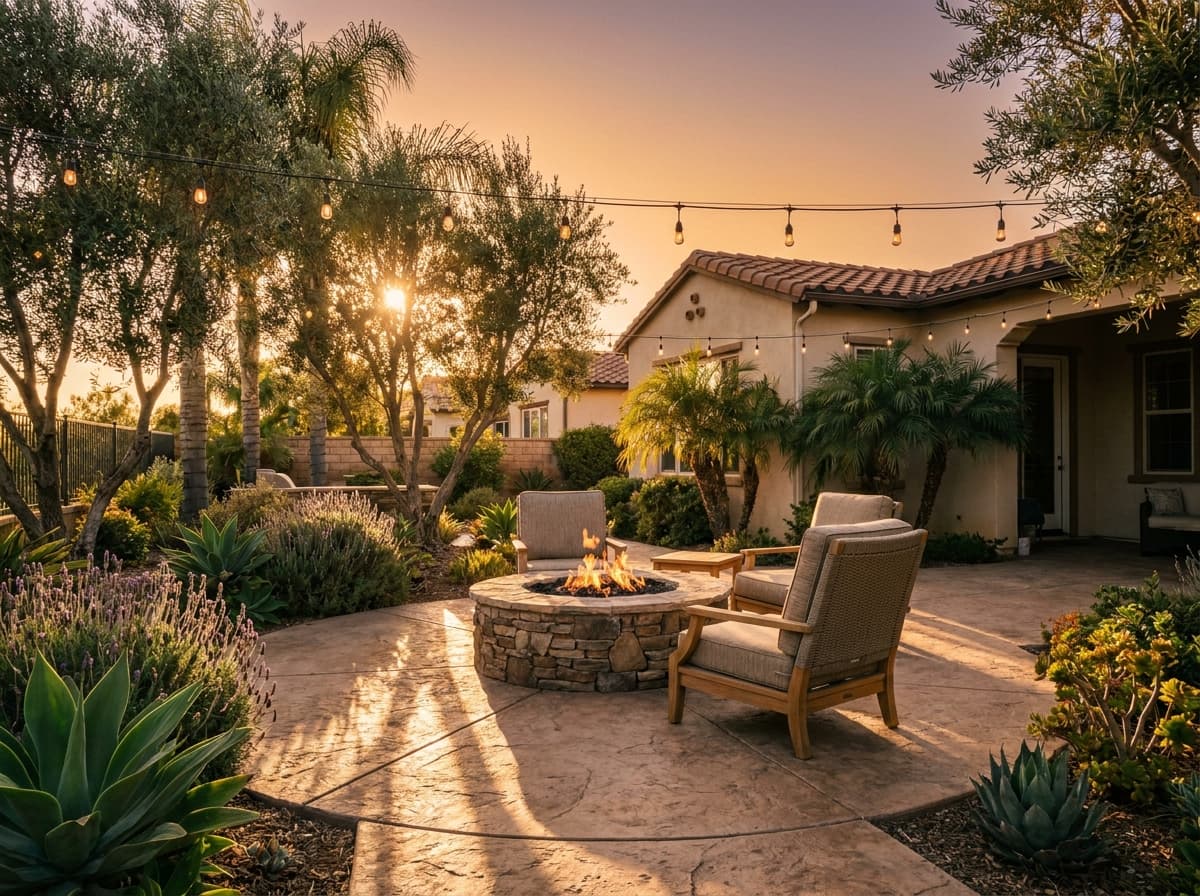
We build both, and we do not have a favorite. What we have is a fairly reliable sense of which yards end up happy with which surface, and it comes down to one trade that almost nobody frames correctly at the start.
Stamped concrete gives you one continuous surface with very little to maintain, and it can crack. Pavers give you thousands of small units that flex instead of cracking and can be lifted and reset, and they ask for a little attention forever. Everything else — pattern, color, texture, how it looks from the kitchen window — is a preference. That one sentence is the actual decision.
The short version
| Stamped concrete | Pavers | |
|---|---|---|
| What it is | A poured slab textured while green | Individual units on a compacted base |
| Handles ground movement by | Cracking | Flexing |
| Repair | Cut out and repour a panel; color will not match | Lift the units, fix the base, put the same units back |
| Ongoing upkeep | Reseal every couple of years | Top up joint sand every few years |
| If you skip the upkeep | Color goes flat, surface wears at traffic lines | Joints empty, weeds seed in the top, units start to rock |
| Continuous pattern across a big area | Yes, seamless | Yes, but it is a grid of units |
| Underground access later | Saw cut and patch | Take up, dig, relay, no visible repair |
| Slip resistance when wet | Depends entirely on texture and sealer | Inherently textured |
| Where the money goes | Concrete, forming, finishing labor, sealer over time | Base labor, base material, laying labor, the units |
Cost, without numbers
We are not going to put a figure on either one, because the figure depends on your access, your grade, your soil, how much demolition there is, and how far a wheelbarrow has to travel. But the shape of the cost is worth understanding, because it explains why quotes come out where they do.
Stamped concrete is front-loaded into a small number of expensive days. The base and steel go in like any structural pour, then the whole surface is placed, colored, stamped, and detailed in essentially one session. Labor per square foot is comparatively low on large open areas because the same crew covers a lot of ground at once. The ongoing cost is sealer — a recurring, modest, predictable expense that never ends, plus somebody's Saturday or a service call every couple of years.
Pavers are labor. Excavating deeper, hauling more spoil off, placing and compacting base in lifts, screeding, laying, cutting borders on a wet saw, setting edge restraint, sweeping and setting joint sand. Almost all of the cost is in things you will never see. The units themselves are usually not the expensive part, which is why swapping to a fancier paver often moves the total less than people expect, and why a suspiciously cheap paver quote is almost always short on base.
The trap in comparing the two on price: a paver quote that matches a stamped quote per square foot is usually not building the base the pavers need. The labor genuinely is higher. If the numbers come out level, ask what the excavation depth is.
How each one fails
This is the part worth reading twice, because both surfaces last a long time when built well, and the way they end is what you are actually choosing between.
Stamped concrete
It cracks. Every slab does — shrinkage is a material property, not a workmanship failure. Good work puts the crack in a saw-cut joint, and on stamped work those joints are laid out to follow the pattern lines so a joint reads as a grout line rather than a scar. But a crack that forms outside a joint on a stamped surface is more visually damaging than the same crack on a broom finish, because it runs across a pattern that your eye is already tracking. It interrupts something.
The sealer wears and then it looks worse than no sealer. Sealer is what makes stamped color look deep and wet. As it wears, it goes first in the traffic lines — the tire tracks, the path from the door to the barbecue — so you get a surface with a glossy periphery and a dull stripe through the middle. It looks neglected before it is.
Color changes with sun and traffic. Integral color and broadcast hardener are in the concrete, so nothing peels the way paint would. But ultraviolet softens tone over years, and the antiquing release that gives the finish its depth sits in the low spots of the texture, where foot traffic gradually polishes it out. The finish ten years in is a quieter version of the finish on day one. Resealing restores a lot of that. It does not restore all of it.
Repairs are visible. Forever. This is the honest headline. A panel that has to come out and be repoured will not match the surrounding slab in color, and matching a stamp pattern across a new joint requires the same mats and a lot of luck. We can make it look deliberate. We cannot make it look original.
Pavers
They settle. Not because the pavers failed — the units will outlive everyone involved — but because something under them moved. Base that was compacted in one deep lift instead of several, a soft spot in the subgrade, water finding a path through the base and washing fines out of it, a utility trench that was backfilled loose years ago.
Edges spread. A paver field is interlocked only as long as its perimeter is held. Edge restraint that was pinned into soil instead of compacted base lets the outer course creep, joints open, and the loosening works inward.
Joint sand leaves. Pressure washing at the wrong angle, hard rain running across a slope, a leaf blower held too close. Empty joints stop transferring load between units, and units that carry load individually start to rock.
Weeds and ants. Not from underneath if the base is right, but seed blows onto the surface and germinates in the top of a joint. Polymeric sand reduces this a lot and does not eliminate it.
Individual units stain. Oil drips, barbecue grease, rust from a planter. The upside is that one paver can be swapped for a spare. The downside is that a brand-new paver next to ten-year-old ones does not match either — weathering is real, and the new one will look new for a couple of years.
The repair is real work. "Pavers can be lifted and reset" is true and it is the strongest argument for them, but it is not a five-minute job. A properly fixed settled area means pulling the units, taking out the failed base, recompacting in lifts, re-screeding bedding, relaying, and re-sanding. It is a day or more of labor. What you get for it is a repair that disappears, which a slab can never offer.
The upkeep you will actually do
Be honest with yourself here, because this is where people choose wrong.
| Stamped concrete | Pavers | |
|---|---|---|
| Weekly | Blow or sweep | Blow or sweep |
| Occasional | Hose off; mild cleaner for spills | Hose off; pull the occasional weed from a joint |
| Every few years | Reseal — clean, dry, recoat | Top up and reset joint sand |
| Every decade or so | Assess whether color needs refreshing | Reset any area that has settled |
| If you do nothing at all | Dull, uneven-looking finish; more staining | Open joints, rocking units, spreading edges |
The stamped answer has fewer events but each one is a project — the surface has to be clean and dry, and it either occupies your weekend or it is a service call. The paver answer is smaller, more frequent, and more forgiving of being late.
If nobody in the household is going to reseal anything, ever, that is a genuine argument for pavers — or for a broom-finish slab, which asks for nothing at all.
Which yard suits which
Stamped concrete is usually the better answer when:
- The area is large, open, and simple in shape.
- You want a continuous pattern across a big surface with no visible grid.
- Nothing under the surface will need to be dug up.
- The soil is stable and the drainage is straightforward.
- You want the lowest week-to-week attention, and you will actually reseal.
- The look you are after is stone or slate texture on a scale that pavers cannot produce without a lot of cutting.
Pavers are usually the better answer when:
- There are mature trees nearby. Roots lift a slab into a crack; they lift a paver field into a bump that can be reset.
- The soil is expansive clay that moves seasonally.
- Something is buried under it, or might be — irrigation main, pool plumbing, a future gas line, a sewer lateral.
- The area is curved, terraced, or cut up by planters and steps.
- Drainage is difficult and you want a permeable surface that lets rain through the joints instead of shedding it somewhere.
- You want the whole thing to be repairable without a visible patch.
- You need to use it immediately — pavers do not cure.
Both are wrong when the base is not going to be built properly. A stamped slab on an uncompacted base cracks. A paver field on an uncompacted base settles. The two surfaces fail differently but they fail for the same reason, and the cheapest version of either one is a worse outcome than a well-built version of the other. If a quote is notably low, the savings are underground.
Two things people expect to be different, and are not
Heat. Neither surface is cool in full sun. Color drives surface temperature far more than material does — a dark charcoal paver and a dark charcoal stamped slab are both hot to stand on at four in the afternoon in July, and a light warm tone in either material is meaningfully more comfortable. If barefoot use matters, choose the color first and the material second.
Slip. Pavers start with an advantage because they are inherently textured and the joints break up sheeting water. Stamped concrete can absolutely be made slip-resistant — texture in the stamp, a grit additive in the sealer at steps and edges — but it is a decision somebody has to make, and a high-gloss sealer on a smooth stamp pattern near water is genuinely slippery. That is a sealer choice, not an indictment of stamped concrete, but it is a choice that gets made badly often enough to be worth naming.
If you already have a slab
Worth knowing before you tear anything out: if your existing concrete is structurally sound and simply tired, a stamped or stained overlay puts a new decorative finish on top without demolition. It is a real option and it costs less than starting over.
The condition is genuine, though. If the slab is moving, if it has cracks with a step across them, or if the base under it has failed, an overlay reprints the problem in a nicer color and you will see the same cracks come through. Anyone willing to overlay a slab without looking at why it cracked is selling you a two-year finish.
Pavers can also go over a sound slab in some situations, set on a bedding course with the perimeter detailed to hold them. It is not the default, and it needs the drainage thought through, but on the right job it beats demolition.
What to ask before you decide
- What is the base build, and how is it compacted? In lifts, with a depth stated for your use. Same question for both surfaces. This is the question that separates real quotes from cheap ones.
- For stamped: where are the control joints going, and how do they relate to the pattern? Someone who has thought about it will describe the panel layout in terms of the design. Someone who has not will cut joints wherever they land.
- For stamped: what sealer, what maintenance interval, and do you come back and do it? You want a real interval and a real answer about who performs it.
- For pavers: what edge restraint, and what is it pinned into? Base, not soil. This is the single most common paver shortcut.
- For pavers: am I getting spare units from the same run? Keep them. In five years the same paver in the same color from a different production lot will not match, and a handful of spares in the side yard is the difference between an invisible repair and an obvious one.
- Where does the water go? They should be able to point at it, on either surface.
- What happens in ten years if this settles or cracks? Listen for whether the answer is honest about visible repairs. Anyone who tells you their stamped work will not crack, or that a paver field never needs joint sand, has told you something useful about the rest of their answers.
Stamped, stained, and patterned finishes in ashlar, slate, and custom textures — the premium look without paver upkeep.
Read next
- How Thick Should a Concrete Driveway Be?Four inches, six, or more — what actually decides driveway thickness, why the base matters more than the number, and where RV pads differ.10 min read
- Why Concrete Cracks, and Which Cracks MatterAll concrete cracks. How to tell a harmless shrinkage hairline from a crack that means the base under your slab has failed, and what to do about each.12 min read
- How Long Before You Can Drive on New Concrete?Foot traffic in about a day, vehicles in about a week. Why the 28-day figure is misunderstood, what damages young concrete, and how heat changes a cure.11 min read