
How Long Before You Can Drive on New Concrete?
Foot traffic in about a day, vehicles in about a week. Why the 28-day figure is misunderstood, what damages young concrete, and how heat changes a cure.
· 11 min read
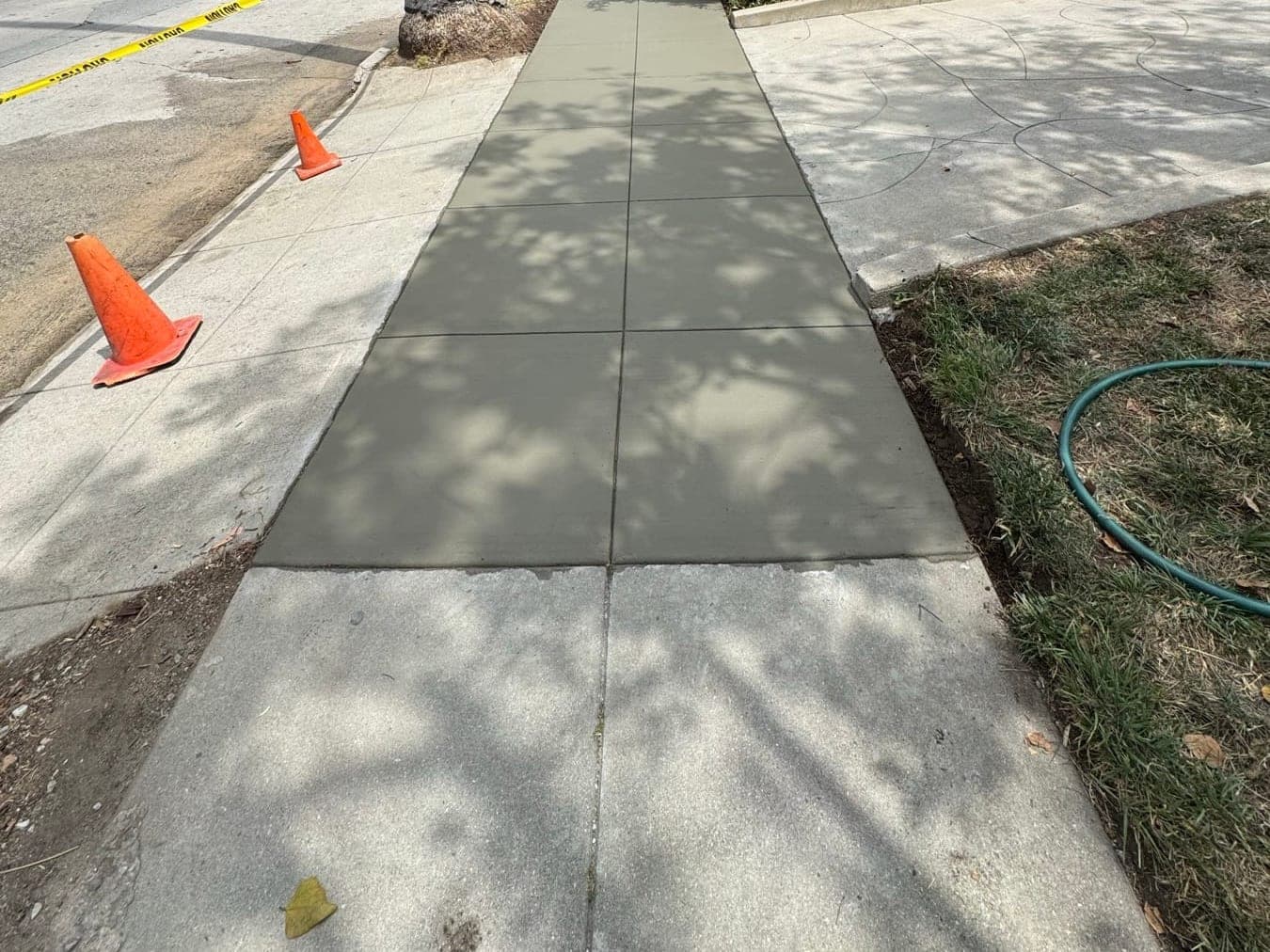
Keep off it on foot for about a day. Keep vehicles off it for about a week. That is the working answer for a normal residential driveway in Southern California, and for most people it is the whole answer.
The reason it is not a single number is that concrete does not finish. It stops being soft, then it stops being fragile, then it keeps quietly getting stronger for years. What you are really asking is at what point is my slab strong enough that the thing I want to put on it will not leave a mark on it forever, and that depends on what the thing weighs and how it sits.
The timeline
| When | What it will take | Notes |
|---|---|---|
| Same day, after finishing | Nothing. Not a footprint, not a dog. | The surface is still soft enough to take an impression |
| 24 hours | Careful foot traffic | Forms usually come off around here |
| 2–3 days | Normal walking, kids, a hose | Still avoid dragging or scraping anything across it |
| 5–7 days | Patio furniture, bikes, planters | Set them down, do not drag them |
| ~7 days | Cars and light trucks | The standard "you can drive on it" mark |
| 2 weeks | Heavier pickups, a loaded trailer moved on and off | Avoid parking a loaded trailer on its jack |
| ~28 days | RVs, box trucks, sustained heavy point loads | This is where the 28-day figure actually belongs |
| 28 days minimum, often longer | Sealer on decorative work | The slab has to be dry, not just strong |
Those are the dates we hand out, and we leave barricades up with the specific date written on them, because the most common early damage we see is not the homeowner. It is a delivery driver reversing onto a four-day-old slab because nothing physically stopped them.
Set is not cure
Two different things happen after a pour, and mixing them up is where most confusion starts.
Setting is the slab going from liquid to solid. It happens in hours. It is what the crew is timing the finishing work around — bull float, edging, brooming, saw cuts — and once it has happened, the slab holds a shape and will not take a handprint.
Curing is the chemical reaction that makes concrete strong. Cement and water combine into interlocking crystals, and that reaction keeps running as long as there is water available for it. It runs fastest in the first days, slows down through the first weeks, and never quite stops. A slab that has set is solid. A slab that has set is not yet strong.
The practical consequence: a driveway that looks completely finished on day two — dry, gray, walkable, nothing sticky about it — is at a fraction of the strength it will have next week. It looks done long before it is done. Every early-damage story starts there.
Where "28 days" comes from, and why it misleads people
Twenty-eight days is a testing convention. When concrete is specified, its strength is defined by what a test cylinder from that batch measures at twenty-eight days. That is the number engineers design around, and it became the number everybody repeats.
What it is not:
- It is not the day the concrete is finished. Concrete keeps gaining strength well past a month. A slab at a year is stronger than the same slab at twenty-eight days.
- It is not the day you can start using it. By the end of the first week a slab has most of the strength it will have at a month. The curve is steep early and flat late. That is why the practical driving date is around seven days and not twenty-eight.
- It is not a guarantee. It describes what a cylinder cured under controlled conditions does. Your driveway is not in a lab. If it dried out in a Santa Ana wind on day two, the top of it never got the water it needed and the surface will be weaker than the number implies, regardless of what the ticket said.
So when someone tells you to wait twenty-eight days to drive on a driveway, they are being cautious with a number that was never about driving. And when someone tells you the twenty-eight-day figure means the concrete is "done," they have it backwards.
What actually damages young concrete
It is almost never the total weight. It is pressure concentrated in a small area, or force applied sideways.
Point loads. A vehicle spreads its weight over four tire contact patches. A trailer tongue jack, a motorcycle kickstand, a scissor jack, a ladder foot, or an RV leveling jack puts a comparable load through a couple of square inches. Young concrete under a point load punches or dishes. The mark does not come out.
Turning wheels while stopped. Power steering turned at a standstill grinds the tire against the surface. On a slab that is a week old, and especially on a hot afternoon, that scuffs the finish and can tear the surface paste. It shows up as a dark curved smear that no amount of washing removes. Roll while you turn, for the first month.
Dragging. A planter, a table leg, a metal trash can, a jack stand slid into position. Lift, do not drag.
Impact. A dropped tool, a piece of rebar, someone unloading pavers off a tailgate. Green concrete chips where cured concrete would shrug.
Water where it should not be. Sprinklers running onto a fresh slab are not a problem for strength — but a sprinkler that hits one strip of the slab every morning while the rest bakes creates a wet-dry cycle in one area during the period when the surface is still consolidating. Turn the zone off for a week.
Chemicals. Fertilizer spilled on a young slab, pool chemicals, deicer nobody in Southern California should own anyway. The surface paste on new concrete is more vulnerable than it will ever be again.
Landscape crews following the pour. This is a real one. A wheelbarrow of wet base material run across a three-day-old walkway, or a plate compactor set down on it, will leave a permanent record of the day. Sequence matters, and it is worth saying out loud to whoever comes next.
Hot weather is the local problem
Southern California pours are hot-weather pours for a lot of the year, and heat changes the job in two directions at once.
Heat accelerates the reaction. The slab sets faster, the finishing window compresses, and the saw-cutting window arrives earlier. A crew working a hot day is working against a clock that a cool morning would not impose.
Heat also removes the water the reaction needs. Evaporation from the surface of a fresh slab climbs with air temperature, concrete temperature, low humidity, and — most of all — wind. Santa Ana conditions are the worst combination available: hot, bone dry, and moving fast. On a day like that the surface can lose water faster than bleed water rises to replace it, which gives you a skin that shrinks and tears while the concrete under it is still soft. Those short surface cracks that appear before the crew leaves are that, and they are avoidable.
What good practice looks like on a hot pour:
- Pour early. The morning is a different material than the afternoon.
- Wet the base and the forms before the concrete arrives, so a dry base does not pull water out of the bottom of the slab.
- Shade and windbreaks where the site allows it.
- Fog the surface or use an evaporation retarder between finishing passes — not to add water to the mix, which weakens it, but to slow what is leaving.
- Start curing immediately, not at the end of the day.
That last one is the one that gets skipped.
Curing means keeping water in
Curing is not "letting it dry." It is the opposite. The reaction needs water, so curing is whatever you do to stop the slab losing it too fast for the first several days.
| Method | How it works | Where it fits |
|---|---|---|
| Water cure — soaker hose, sprinkler, wet burlap | Keeps the surface continuously damp | The most effective option; needs someone to keep it going |
| Curing compound sprayed on | Forms a membrane that slows evaporation | Practical on large flatwork; check compatibility with anything going on top later |
| Plastic sheeting | Traps moisture | Effective, but it can blotch colored concrete wherever it touches unevenly |
| Nothing | Surface loses water, top layer stays weak | Dusting, surface crazing, early wear |
A slab that was not cured looks identical to a slab that was, on day one. The difference shows up as a surface that dusts under a broom, wears through where tires track, and holds stains it should have shed. The top eighth of an inch is the part you touch, look at, and hose down, and it is the part that suffers first when curing is skipped.
If your pour happened on a hot day and nothing was done to it afterwards, that is the question to ask about — not the mix.
Decorative and stamped work runs on a different clock
Stamped concrete adds a step that lengthens the wait, and it catches people out.
Sealer cannot go onto damp concrete. If it does, it traps moisture under a film and turns cloudy, white, or blotchy, and the fix is stripping it and starting over. So the first sealer coat waits until the slab is genuinely dry through, which on a thick slab in cool weather can be well past a month. A contractor who seals a stamped patio on day ten because the schedule says so is buying themselves a callback.
You can walk on stamped work on the same schedule as any other slab. It is the sealing, and everything that follows sealing, that waits.
Weather, cool nights, and the shoulder seasons
Cold is not really our problem here, but cool is. Concrete poured into a cool evening sets slowly, which is fine for finishing and awkward for scheduling — the saw cuts happen when the slab is ready, not when the crew wants to go home. A pour that goes down in the afternoon in December can put the joint-cutting window somewhere inconvenient after dark.
The one weather event that does matter is rain on fresh concrete. Rain landing on a slab that has not set yet dilutes the surface paste and can leave a pitted, washed finish that never fully comes back. A crew watching a forecast and rescheduling a pour is doing you a favor, even when it costs you a week.
What early damage looks like afterwards
- A curved dark scuff at the top of the driveway where someone turned their wheels standing still.
- A dished circle the size of a jack foot.
- Chipped edges where the forms came off too early or something was dropped.
- A dusty surface that leaves gray on a broom for years — a cure that never happened.
- Tire marks that will not wash off on sealed decorative work, especially where a hot tire sits in the same spot.
Almost none of this is repairable in the sense people hope. Grinding a scuff changes the texture. Patching a dish leaves a color difference. The slab works fine; it just carries the record.
Can you shorten the wait?
Sometimes, and it is worth knowing what the levers actually are before you ask for them.
A high-early-strength mix gets you to a usable slab faster — more cement, a different cement, or an accelerating admixture, all pushing the reaction to run harder up front. It works. It also costs more, it sets faster in weather that was already setting it fast, and it compresses the finishing and saw-cutting windows for the crew. On a one-car driveway where the household genuinely has nowhere else to park, it can be the right call and we will price it as an option. On a job where the wait is merely inconvenient, it is money spent to buy a few days.
Fibers in the mix help with plastic shrinkage cracking. They do not make the slab drivable sooner.
Pouring in sections is the underrated answer. If the driveway can be poured in two stages along an existing joint line, one half is available while the other cures. It costs a mobilization and it leaves a cold joint that has to be planned into the layout, but it solves the actual problem, which is usually access rather than strength.
Pavers do not cure at all. An interlocking paver driveway is walkable the day the joints are set and drivable as soon as the crew is off the site. If a week without the driveway is a genuine hardship rather than an annoyance, that is a real consideration in the surface choice, not a footnote.
What to ask before the pour
- What date can I drive on it, and will there be barricades? You want a specific date, and something physical stopping a delivery driver.
- How is it being cured, and starting when? "Immediately" is the right first word. Then a method.
- What is the plan if it is hot that day? Early start, wet base, retarder, fog. Any of those signals someone has done this in August.
- When are the joints being cut? Same day or first thing the next morning, depending on the weather. If nobody can tell you, expect a random crack.
- Who is coming onto the site after you, and when? If a landscape crew, a pool crew, or a fence contractor is scheduled behind the pour, somebody has to tell them the date too.
- For decorative work: when is it getting sealed, and what happens if it is not dry? The right answer is that the schedule waits for the slab.
Broom-finish and decorative driveways, approach aprons, and reinforced RV pads that carry the load and drain right.
Read next
- How Thick Should a Concrete Driveway Be?Four inches, six, or more — what actually decides driveway thickness, why the base matters more than the number, and where RV pads differ.10 min read
- Why Concrete Cracks, and Which Cracks MatterAll concrete cracks. How to tell a harmless shrinkage hairline from a crack that means the base under your slab has failed, and what to do about each.12 min read
- Broom, Smooth, or Exposed Aggregate?Broom for almost anything outdoors, smooth for indoors, exposed aggregate where grip matters most. Slip, heat, cleaning, and where each finish belongs.11 min read