
RV Pads: What Changes When It Parks for Months
Six inches and heavier steel is the starting point. What sustained jack loads, drainage, and months of parking change about a pad, and how to size one.
· 11 min read
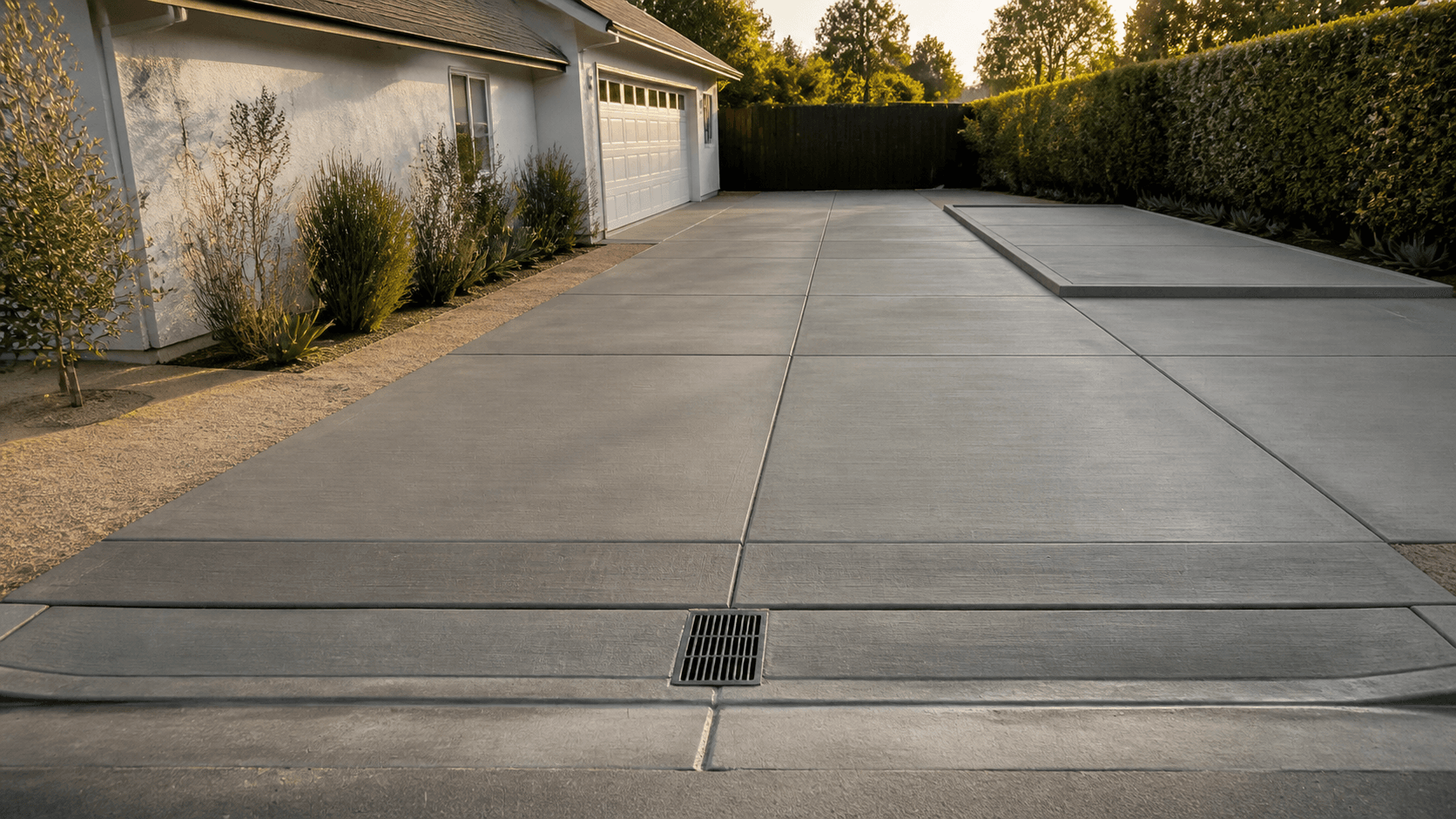
Six inches of concrete over a deeper, properly compacted base, with a heavier rebar grid than a driveway gets. That is the usual starting point for an RV pad, and for a lot of coaches it is also the finishing point.
But the thickness is the least interesting part of the answer. A driveway is designed for a load that arrives, spreads over four tires, and leaves. An RV pad is designed for a load that arrives and then stays — often for months, often on four or six leveling jacks with contact patches the size of a dinner plate. Nothing else in residential concrete works that way, and almost everything that goes wrong with RV pads traces back to that one difference.
What changes, in one table
| Driveway | RV pad | |
|---|---|---|
| Slab | 4" typical | 6" typical, more for heavy coaches or poor soil |
| Load type | Transient, spread over tires | Sustained, concentrated at jacks |
| Steel | Rebar grid, chaired | Heavier grid, tighter spacing, chaired |
| Base | Compacted in lifts | Deeper, compacted in lifts, extra work under the jack line |
| Edges | Standard | Thickened where wheels cross |
| Drainage | Shed to the street | Shed away, and it has to work with a vehicle sitting on it |
| Utilities | Rarely | Sleeves for power, water, and sewer, placed before the pour |
| Finish | Broom | Broom |
Why "parked" is the whole problem
Two mechanisms, and both of them need time to do damage — which is exactly what a parked coach provides.
Soil consolidates under sustained load. Compacted base and subgrade have some air and water in the voids between particles. Put a heavy, continuous load on them and that gets squeezed out slowly. A truck rolling across applies its load for a fraction of a second and the soil never notices. A jack foot pressing down through the same slab for four months lets the material underneath consolidate, and it consolidates most where the pressure is highest. That is settlement, and it happens under a slab that would have carried the same vehicle driving over it indefinitely.
Concrete itself creeps. Under a long-held load, concrete deflects slowly and keeps some of that deflection permanently. It is a small effect and it compounds with the first one.
The result: a pad that looked perfect the day the coach arrived can have a low spot at each jack the following spring, and once there is a low spot, water collects in it, which softens the base, which deepens the low spot.
Punching, not just bending
There is a second failure mode that a driveway rarely sees.
Most slab cracking is bending — the slab spans a soft area and pulls apart in tension at the bottom. Steel in the slab resists that, and control joints steer where it shows.
A concentrated load on a small footprint can instead punch: the slab fails in shear around the perimeter of the load, pushing a cone of concrete down into the base. You see it as a ring of cracks around the contact point, or as a dished area with hairline cracks radiating out. It takes thickness and steel to resist, and it takes a bigger contact area to avoid entirely.
Which brings us to the single cheapest thing an RV owner can do for their concrete:
Use jack pads. Always. Even on a good slab. A purpose-made leveling pad, a stack of solid wood blocks, or a thick plastic pad under each jack foot spreads that load over a much larger area. It turns a punching problem into a bending problem, and a bending problem into a non-problem. It also keeps the jack foot from marking the surface, and it makes leveling on a slightly sloped pad safer.
The rule of thumb we give people: the bigger the pad, the better, and rigid beats flexible. A thin pad that bends under the jack transmits most of the load through its center anyway and has done less than it looks like it has.
Thickness, and why it is not the answer on its own
Six inches is the working default. Heavier coaches, softer soils, or a pad that will also take a truck-and-trailer combination go thicker, and there is nothing wrong with going thicker if the reason is real.
But thickness is a bad substitute for base work, and it gets sold that way. A six-inch slab on a base that was dumped in one lift and compacted from the top is a thicker bridge over the same voids. An extra two inches of concrete costs real money and buys you very little if the ground under it is not uniform.
The order of importance, honestly: uniform compacted base first, steel placed correctly second, thickness third. Anyone whose pitch leads with thickness and goes quiet about excavation depth has told you where the money is not going.
Steel
Rebar on a grid, tied, and chaired up so the steel sits inside the slab. Same principle as a driveway and more so, because the loads are worse.
Three things change from driveway practice:
- Tighter grid spacing, which distributes a concentrated load into more of the slab rather than into whatever single bar happens to be near it.
- Heavier bar on pads carrying larger coaches.
- Attention to where the steel sits vertically. Under a point load, the slab goes into tension on top around the load and on the bottom between supports. Steel positioned thoughtfully within the thickness does more than steel that just ended up somewhere in the middle. On heavier pads that can mean two mats rather than one.
Wire mesh is not adequate here. It is barely adequate on a driveway, and the reason is the same: it does nothing unless it stays lifted into the slab during the pour, and on a real job it gets walked down onto the base in the first ten minutes. Steel lying on the subgrade is a rust stain with extra steps.
Base and subgrade, and the jack line
The base under an RV pad is deeper than a driveway's and it goes in the same way: a few inches at a time, each lift compacted before the next. There is no version of this where a deep base is compacted in one pass — compaction energy does not reach the bottom of a thick pile, and the bottom half consolidates later under your coach.
Two additions specific to RV pads:
Know where the jacks land. If you already own the coach, we can measure it. Jack points and tire tracks fall in predictable lines, and those lines are worth extra care in the subgrade — soft material removed a little deeper, base placed a little thicker, compaction verified rather than assumed.
Run the base past the slab edge. The perimeter of any slab is its weakest region, and the edge of an RV pad takes a tire crossing it every time the coach comes and goes. Base that stops exactly at the form line leaves the edge sitting over the transition between compacted base and native soil. We carry the base out past the edge and thicken the concrete where wheels cross.
Drainage, which is the section people skip
A pad with a large vehicle parked on it for months is a pad that is shaded, that gets very little sun to dry it out, and that has a roof over it collecting and shedding rain to its perimeter.
The consequences:
- Water that ponds under a parked coach stays there. It softens the base directly beneath the vehicle, which is the one place you cannot inspect.
- Runoff off the coach concentrates at the drip line, which is often right at the slab edge — the weakest part.
- Spills happen. Engine drips, a gray tank connection that seeps, a water hose left dribbling. A pad that sheds is a pad that does not hold any of that against the concrete.
So the pad falls to somewhere, that fall is laid out before the forms go in, and "somewhere" is not toward the house, the garage, the foundation, or over the property line onto a neighbor. Where the water can legally and practically go varies by city and by lot, and we confirm that during the estimate rather than guessing at it.
Size and layout
Getting the dimensions wrong is more common than getting the structure wrong, and it is harder to fix.
- Length for the coach plus the hitch or tow bar, plus room to walk around the back.
- Width with the slide-outs deployed, not retracted. This is the most frequently regretted dimension.
- A door-side apron so the steps land on concrete and the awning covers something you want to sit on. A pad you cannot step off of onto anything but dirt gets muddy fast.
- Approach and turning radius. A pad that requires a fourteen-point turn to get onto will get used less than you expect. The approach matters as much as the pad.
- Overhead clearance — branches, eaves, service drops. Worth walking before anything is formed.
- Where the jacks land relative to the slab edges. Jacks near an edge are the worst case for both punching and edge failure.
A common cost-saving layout is a ribbon pad: two concrete strips under the tires with gravel, decomposed granite, or turf between them. It works, it uses less concrete, and it drains well. The condition is that the leveling jacks have to land on concrete, not on the strip between — which usually means widening the strips or adding a cross pad at the jack line. A ribbon pad where the jacks come down on gravel is a ribbon pad that will need leveling blocks forever and will still sink.
Utilities go in before the pour
Sleeves and conduit under a slab are cheap the week before the pour and miserable afterwards. Even if you are not installing power, water, or a sewer connection now, running empty conduit across the pad while it is open costs almost nothing and saves a saw cut later.
What that installation is allowed to look like — electrical service, water connection, sewer cleanout — varies by city. We confirm it during the estimate and handle the coordination rather than leaving you to find out afterwards.
Finish, and what not to bother with
Broom. It grips, it hides the marks a working surface collects, and it hoses off. A hard-troweled RV pad would be slick under wet feet and would show every drip.
Sealing is optional. There is a reasonable argument for it — sustained drips from an engine or a generator soak into unsealed concrete and stain permanently. There is an equally reasonable argument against, which is that it starts a maintenance cycle for a working surface most people do not look at closely. If you seal, penetrating rather than a film, because hot tires lift films.
Curing matters more than usual. A thick slab poured in heat needs the cure started immediately and kept going. And the coach stays off it for about a month — this is one of the few residential situations where the twenty-eight-day figure genuinely applies, because you are about to apply exactly the kind of sustained concentrated load that number was meant for.
The unhelpful version
If your soil is expansive clay, the yard drains poorly, and the coach is heavy, no thickness of concrete fixes that. The fix is drainage and base work, and it costs more than the slab. We would rather tell you that at the estimate than pour a pad that dishes in two years.
And in the other direction: if you park a small travel trailer for a few weeks a year and pull it out every month, a six-inch reinforced pad may be more than the job needs. A properly built four-inch slab with good base under it, or even a well-built gravel pad with a concrete jack area, can be the honest answer. We will say so.
Gravel deserves one sentence of fairness: it is cheap, it drains, and it ruts, migrates, grows weeds, and swallows jack feet. It is a real option for occasional use and a poor one for a coach that lives there.
What to ask
- How deep are you excavating, and what base depth goes back in — compacted how? In lifts, with a number. This is the question.
- What thickness, and why that thickness? There should be a reason connected to your coach and your soil.
- What steel, at what spacing, and how is it held up? Chaired rebar on a grid. Not mesh.
- Do you want to measure where my jacks land? A contractor who asks this before you do has built RV pads.
- Which way does it fall, and where does the water end up? They should point.
- Are we sleeving for utilities while it is open? Even if you are not connecting anything yet.
- When can the coach go on it? About a month, and anyone who says a week has not thought about jack loads.
- How wide, with the slides out? Make them answer with the slides out.
Broom-finish and decorative driveways, approach aprons, and reinforced RV pads that carry the load and drain right.
Read next
- How Thick Should a Concrete Driveway Be?Four inches, six, or more — what actually decides driveway thickness, why the base matters more than the number, and where RV pads differ.10 min read
- Why Concrete Cracks, and Which Cracks MatterAll concrete cracks. How to tell a harmless shrinkage hairline from a crack that means the base under your slab has failed, and what to do about each.12 min read
- How Long Before You Can Drive on New Concrete?Foot traffic in about a day, vehicles in about a week. Why the 28-day figure is misunderstood, what damages young concrete, and how heat changes a cure.11 min read