
How Often Should Drip Irrigation Run?
Emitter flow, soil type, and season decide it, not minutes. Why drip runs on a different clock from lawn zones, and how to check rather than guess.
· 11 min read
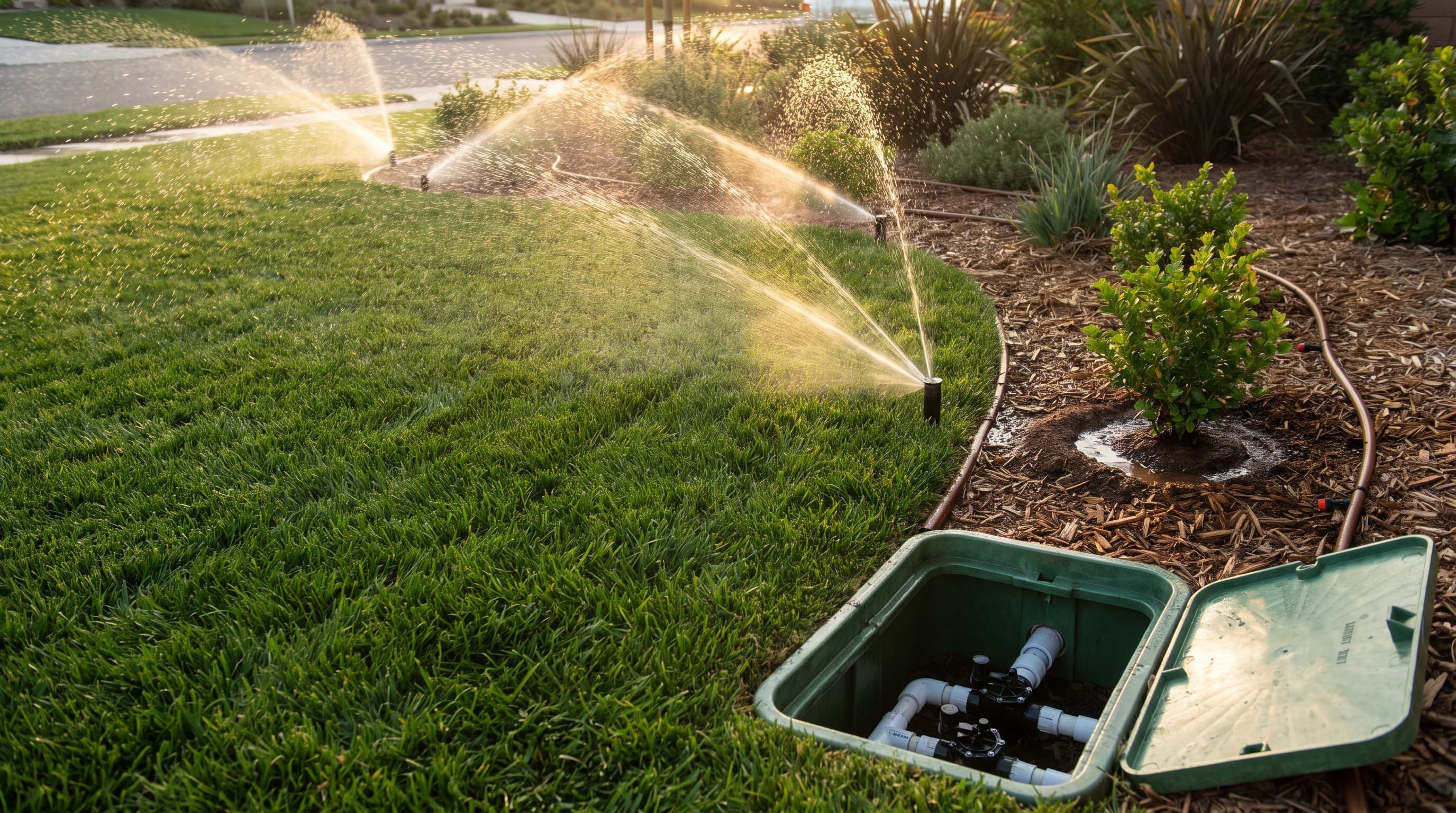
Much longer, and much less often, than a lawn zone. A drip zone that runs twelve minutes four times a week is not watering your plants — it is keeping the top inch of soil damp, which is the fastest way we know to kill a shrub while believing you are looking after it.
A useful starting point for established planting on drip in summer is one long run, two or three times a week, with the run measured in tens of minutes rather than single digits. But "long" and "often" only mean something once you know two numbers: how much water your emitters put out per hour, and how fast your soil takes it.
Drip runs on a different unit
Sprinklers are measured in inches per hour — a rate spread over an area. Drip is measured in gallons per hour at a point. You cannot convert one into the other by intuition, and that is the whole reason drip zones need their own valve and their own thinking.
Standard point-source emitters come in 0.5, 1, and 2 gallons per hour. Inline dripline usually carries emitters rated around 0.6 or 0.9 gallons per hour, spaced every 12 or 18 inches along the tube. Those are the numbers on the box, and they are what the run time has to be built around.
The arithmetic is simple once you have them:
| Setup | Run time | Water delivered |
|---|---|---|
| One 1 gph emitter | 10 minutes | About one sixth of a gallon |
| One 1 gph emitter | 60 minutes | 1 gallon |
| Two 1 gph emitters on one shrub | 45 minutes | 1.5 gallons |
| Four 2 gph emitters on a young tree | 60 minutes | 8 gallons |
| Four 2 gph emitters on a young tree | 90 minutes | 12 gallons |
Look at the first row. Ten minutes of a one-gallon-per-hour emitter delivers about a sixth of a gallon — call it a couple of cups, spread into the soil around one emitter. A five-gallon shrub in July needs several times that, and a young tree needs an order of magnitude more. That row is why so many drip systems fail while running constantly.
Soil decides the shape of the answer
Water leaving an emitter does not go straight down. It spreads into a bulb, and how wide and deep that bulb is depends entirely on the soil.
| Soil | How water moves | Emitters | Run time | Frequency |
|---|---|---|---|---|
| Sandy | Fast down, little sideways — a narrow deep bulb | More, spaced closer | Shorter | More often |
| Loam | Balanced spread | Moderate | Moderate | Moderate |
| Clay | Slow, wide — a shallow broad bulb | Fewer, spaced wider | Much longer | Much less often |
Clay is the interesting case and the common one here. It takes water slowly, which means a long run is required to get the bulb deep enough to reach the whole root zone. But it also holds that water for a long time, which means running again two days later puts water into soil that is still wet from last time. Long and rare is not a compromise on clay — it is the only schedule that works.
Sand is the mirror image. Water falls through it, the bulb is narrow, and a long single run mostly sends water below the roots where it does nobody any good. Sand wants shorter runs, closer together, and more emitters per plant so the wetted area covers the root ball.
If you do not know which you have, take a handful of damp soil and squeeze. Sand falls apart. Clay forms a ribbon you can bend. Loam holds together and crumbles when poked.
Season is a bigger lever than most people use
Drip schedules should change several times a year, and most of the ones we find have not been touched since installation.
- Peak summer. The heaviest schedule of the year: established shrubs two to three times a week, longer runs, and everything watched.
- Spring and fall. Roughly half of summer, often once a week for established planting. Mild weather with warm soil is when plants use the least water for the most growth.
- Winter. Frequently off entirely for established plants, with a deep soak during a long dry stretch. This is the season that does the most damage, because a controller left on a summer program through a cool wet January produces root rot in plants that were fine in August.
- New planting, any season. Its own program, at the root ball, more frequently than established plants, for the whole first year. More on that below.
A controller that offers seasonal adjust as a percentage is genuinely useful here — dialing the whole program to a fraction of the summer setting is faster than reprogramming every zone. It only works if the summer setting was right to begin with.
Why drip lives on its own valve
Three separate reasons, and any one of them would be enough.
Pressure. Point-source emitters generally want to see something in the range of 25 to 30 psi; some inline products are designed for around 40. Household supply pressure is frequently far above that. Run drip at mainline pressure and fittings blow off the tubing, emitters turn into misters, and the flow rate stops matching anything on the box. That is why a drip valve gets a pressure regulator, and why it is one of the two parts most often left off a cheap install.
Filtration. Emitter orifices are tiny. Any grit that gets past a filter finds one and stays there. A screen filter, typically 150 to 200 mesh, sits at the valve with the regulator. It is the other commonly omitted part, and the reason a system works for two seasons and then starts losing plants one at a time.
Flow. A whole drip zone may use less water per minute than a single rotor. Put drip and sprinklers on the same valve and the sprinklers are set by minutes that starve the drip, or the drip is set by minutes that flood everything the sprinklers reach. There is no middle setting that serves both.
Pressure-compensating emitters are worth specifying anywhere there is a slope or a long run. Without them, the emitters at the low end of a hill deliver noticeably more than the ones at the top, and the plants at the top of the slope are the ones you will be replacing.
How to check, instead of guessing
Every schedule in this article is a starting point. Here is how to find your actual answer, which takes about ten minutes across two days.
- Confirm the emitter flow. Hold a measuring cup under one emitter for exactly five minutes and multiply by twelve. If it does not roughly match the rating, you have a pressure or clogging problem to solve before any scheduling question matters.
- Run a full cycle, then wait about an hour.
- Probe next to the root ball. Push a soil probe or a long screwdriver in beside the plant, 8 to 12 inches down. It moves easily through moist soil and resists in dry soil. If it stops at three inches, the run is too short.
- Probe again the day before the next scheduled run. If it is still wet down there, the frequency is too high. If it went dry a day and a half ago, the frequency is too low.
That two-probe test settles arguments no schedule can. Run time is set by how deep the water gets. Frequency is set by how long it stays.
New plants are a separate program
The most common way a drip system kills a new plant has nothing to do with minutes.
A nursery root ball is made of bark and peat-based container mix, which is far coarser than native soil. Water does not readily cross the boundary between the two, so an emitter sitting eight inches away in the backfill wets the backfill and leaves the root ball bone dry — and the root ball is the plant's entire root system for its first months. The plant wilts, the owner sees damp soil around it, concludes it cannot be water, and the plant dies of thirst in wet ground.
Emitters go on the root ball for the first year, then get added or moved outward as roots expand into the surrounding soil. A tree that had two emitters at planting should have more of them, further out, by year two.
New planting also wants more frequent runs than established planting, for the same reason new sod does: a small root volume dries out fast. The taper off that schedule happens over the first year, not the first month.
Too much water looks like too little
This is the part that traps people, and it is worth knowing before you touch the controller.
An overwatered plant wilts. So does an underwatered one. Leaves yellow, edges brown, growth stalls, and the plant looks like it is asking for water in both cases — because in both cases it is failing to move water into its leaves. The difference is why. A dry plant has nothing to take up. A drowned plant has plenty and no functioning roots left to take it up with, because roots sitting in airless saturated soil rot.
So the leaves tell you there is a problem and nothing more. The soil tells you which problem. Probe beside the root ball before adding a single minute:
- Dry at six inches, plant wilting. Underwatered. Increase run time first, frequency second.
- Wet at six inches, plant wilting. Overwatered. Reduce frequency, and look at whether that spot drains at all.
- Wet at six inches, several plants in the same low corner failing. That is a drainage problem wearing an irrigation costume, and no schedule fixes it.
The last one comes up more than you would think. A bed at the bottom of a slope, or a planter against a slab where water collects, can be waterlogged while the controller is doing everything right.
One valve, one water need
A drip zone can only run one schedule, so every plant on it is being watered as if it had the same requirement. That is fine if the bed was planted that way and painful if it was not.
Grouping planting by water need — thirsty things together, dry-tolerant things together, and neither mixed into the other — is what lets a zone run honestly instead of splitting the difference. It is also why a mature drought-tolerant bed with three thirsty additions dropped into it over the years ends up either killing the natives with kindness or starving the newcomers.
Exposure counts as a water need. A bed against a west-facing stucco wall takes direct sun plus radiated heat, and it will want more than an identical bed of identical plants on the north side. Those belong on different valves even if the plant list is the same.
Maintenance, because drip fails invisibly
The thing about drip is that you cannot see it working from the patio. A sprinkler head that fails announces itself; an emitter that clogs looks exactly like an emitter that is running.
- Walk the zone with it running, once a season. Look at each emitter. Look for wet spots that indicate a blown fitting and dry spots that indicate a missing one.
- Flush the ends of dripline once or twice a year. Open the end cap, let it run until it comes out clean, close it.
- Clean the filter at the same time.
- Watch for the one plant that is not thriving. Nine times out of ten it is a clogged emitter, a chewed line, or an emitter that fell out of the tubing.
- Check tubing that is exposed. Tubing run on top of mulch goes brittle in the sun and gets stepped on. It belongs under the mulch.
- Expect rodents. Gophers and squirrels chew drip line, and the tell is a puddle in one spot and dry plants downstream of it.
Mulch deserves its own line, because two to three inches of it changes the schedule more than any controller setting. Bare soil under an emitter in August loses the top of the wetted bulb to evaporation before the roots get it. Mulch keeps it.
Smart controllers and drip
Weather-based controllers are worth having, with a caveat. They calculate from evapotranspiration, which is a model built around irrigated turf. To do anything sensible with a drip zone they need to be told what is on it — plant type, emitter flow, spacing, soil, exposure, and sometimes the wetted area — and most of the ones we find in the field were installed with the defaults left in.
Entered properly, they are excellent at the seasonal adjustment nobody remembers to do by hand. Entered lazily, they water the wrong thing on a very sophisticated schedule.
What to ask
- What emitter flow are you using, and how many per plant? There should be a number and a reason.
- Is there a pressure regulator and a filter at the drip valve? Both, not one.
- Are the emitters pressure-compensating? Especially on any slope.
- Is drip on its own valve, separate from every sprinkler zone? It has to be.
- Where do the emitters sit on new plantings? On the root ball for the first year.
- What is the starting schedule by season, and where is it written down?
- How do I flush the lines, and where are the ends? You will need to know in a year.
- What is the plan for moving emitters as the plants grow? A drip layout for a new bed is not the layout for that bed in five years.
Zoned sprinklers and drip that put water where it is used, on a controller you can actually read.
Read next
- Half the Lawn Is Brown, Half Is SoggyOne valve watering two different things. Precipitation rates, head-to-head coverage, mixed head types, and the catch-can test that settles the argument.10 min read
- How Thick Should a Concrete Driveway Be?Four inches, six, or more — what actually decides driveway thickness, why the base matters more than the number, and where RV pads differ.10 min read
- Why Concrete Cracks, and Which Cracks MatterAll concrete cracks. How to tell a harmless shrinkage hairline from a crack that means the base under your slab has failed, and what to do about each.12 min read