
Half the Lawn Is Brown, Half Is Soggy
One valve watering two different things. Precipitation rates, head-to-head coverage, mixed head types, and the catch-can test that settles the argument.
· 10 min read
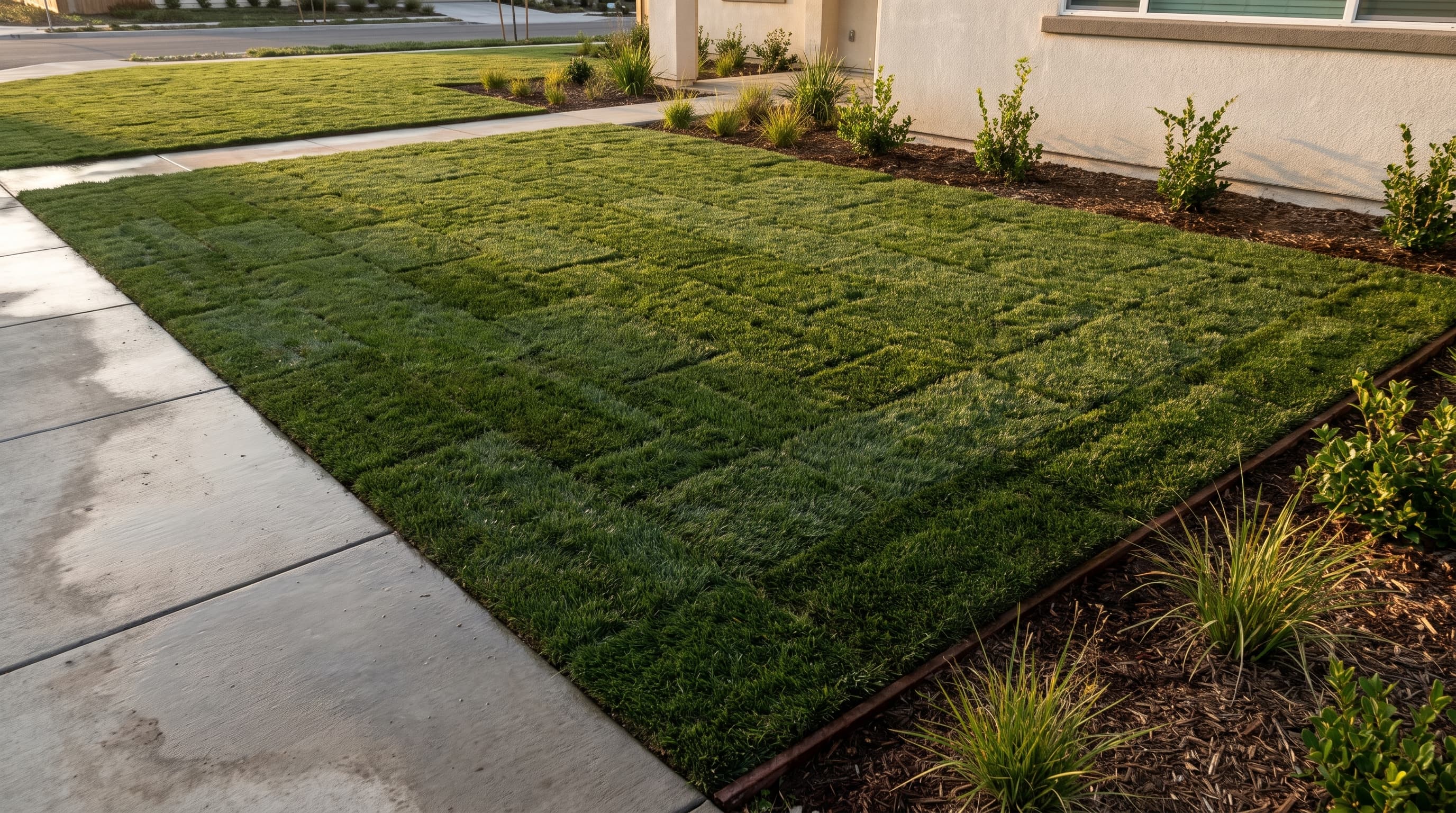
It is almost never the grass, and almost never the controller. In most yards, one valve is being asked to water two things that need completely different amounts of water, and there is no number of minutes that satisfies both.
You cannot fix that at the timer. Set it for the dry half and the wet half drowns. Set it for the wet half and the dry half burns. The problem is upstream of the schedule, which is why turning the dial has not worked.
Precipitation rate, which explains most of it
Every sprinkler applies water at a rate, measured in inches per hour over the area it covers. Different head types are wildly different.
| Head type | Roughly how fast it applies water |
|---|---|
| Fixed spray heads | About 1.5 inches per hour |
| Rotors | About 0.4 inches per hour |
| Rotary nozzles | Roughly 0.4 to 0.75 inches per hour |
| Bubblers and drip | A different unit entirely — gallons per hour at a point |
Now put a spray head and a rotor on the same valve and run it for fifteen minutes. The spray side receives about three eighths of an inch. The rotor side receives about a tenth. Same valve, same minutes, and the spray side got roughly four times as much water.
Do that three days a week for a summer and you get precisely the yard in the title: soggy, spongy, possibly fungal on the spray side, and tan and hard on the rotor side. Both halves are being watered exactly as programmed.
Head-to-head coverage, and the dry ring
Even with matched heads, spacing decides whether coverage is even.
A single sprinkler does not distribute water evenly across its own throw. It applies the most near the head and progressively less toward the outer edge of its radius. That is inherent to how the water leaves the nozzle, and it is not a defect.
The design answer is overlap: each head is placed so its spray reaches the next head. Not most of the way — all the way. The thin outer edge of one head's pattern is topped up by the thin outer edge of its neighbors, and the sum across the middle comes out roughly even.
Fall short of that by even a couple of feet and the sum stops adding up. What you get is a dry ring or a dry band midway between heads, which people usually diagnose as a bad patch of grass. It is a spacing problem, and it will come back every summer.
Where spacing goes wrong:
- Heads were placed where trenching was convenient rather than at the spacing the nozzles need.
- A previous owner added a head, or removed one, or capped one that was leaking.
- The lawn shape changed — a bed was extended, a patio went in — and the head layout never changed with it.
- A head is buried under grown-in turf and no longer pops clear, so its pattern is being blocked at ground level.
Matched precipitation nozzles
There is a subtler version of the mixed-head problem that happens even when every head on the valve is the same model.
A full-circle head has to cover four times the area of a quarter-circle head at the same radius. If both nozzles put out the same flow, the quarter-circle head is applying four times the depth of water over its little wedge. Corners flood, the middle stays dry, and nothing looks obviously wrong at the heads.
Matched precipitation rate nozzle sets solve this by varying flow with arc — a half-circle nozzle flows half what a full-circle nozzle of the same radius flows. It is a small parts choice with a large effect on uniformity, and mixing nozzle families across a zone quietly undoes it.
Radius matters the same way. A 12-foot nozzle next to a 15-foot nozzle on 15-foot spacing leaves a gap the 12 cannot reach, no matter how long the zone runs.
The soggy spot that appears after every cycle
If one area is wet right after the zone runs and reasonably dry a day later, and it happens to be the lowest point on the zone, that is probably not overwatering. It is low head drainage.
When the valve closes, the water still sitting in the lateral pipe has to go somewhere, and it goes out the lowest head on the line. Every cycle ends with the contents of that pipe emptying onto one spot. On a slope it can be a surprising amount of water, several times a week, in a place the schedule has nothing to do with.
The fix is check valves — either heads with built-in check valves or an in-line check at the low head. It is a small repair with an immediate result, and it is one of the most satisfying things to find, because the symptom looks exactly like a watering problem and is not one.
Sun, shade, and root competition
A zone can have perfectly matched heads and perfect spacing and still produce a half-and-half lawn, because the two halves are not in the same climate.
A strip against a south or west-facing stucco wall gets direct sun plus heat radiated off the wall and off any adjacent driveway. It is the hottest, driest microclimate on the property and it will run short of water first, every time. The north side yard on the same valve needs a fraction of what that strip needs.
Under a mature tree there is a second problem stacked on the shade: the tree's roots are in the same soil as the lawn, and they are much better at extracting water than the grass is. A bald ring under a canopy is usually a competition problem, not an irrigation failure, and it is worth saying plainly that you will not out-water a tree. Sometimes the honest answer is that the ring becomes a mulched bed and the lawn stops at the drip line.
Either way, exposure is a zoning criterion. Sun and shade belong on different valves for the same reason spray and rotors do.
Pressure, at both ends
Two failure modes, opposite causes, and both produce uneven coverage.
Too little pressure. Rotors turn slowly or stall, sprays fall short of their rated radius, and heads at the far end of the zone underperform relative to the ones near the valve. Common causes: too many heads on one valve, an undersized or partially closed valve, a partly closed main shutoff, or a leak somewhere on the lateral.
Too much pressure. Heads mist and fog instead of throwing droplets. Fine mist drifts and evaporates, so a meaningful share of the water never reaches the ground — and what does reach the ground lands near the head instead of out at the radius, which shrinks the effective coverage. Misting is the easiest sprinkler fault to spot and one of the most commonly ignored.
Pressure-regulating head bodies solve the high side at the head, which is generally better than trying to regulate the whole zone.
The diagnostic sequence
Do these in order. Most yards are solved by step three.
Run every zone in daylight and watch it. Not at five in the morning. Stand there. You will learn more in twenty minutes than in a whole season of adjusting minutes.
Map the zones. Turn on one valve at a time and mark which heads come on, with flags or chalk. Write it down. Half the mixed-zone problems in the world are invisible until somebody makes this list, and then they are obvious.
Look for the visible faults. Heads that do not pop fully. Heads spraying the fence, the sidewalk, or the house. Arcs rotated out of position by a mower. A head throwing eight feet next to one throwing fifteen. Misting. A geyser where a head has been broken off. Grass grown over a nozzle.
Run a catch-can test. Set six to ten identical straight-sided containers in a grid across the zone. Run it fifteen minutes. Measure the depth in each with a ruler. Two numbers come out of it: the average depth times four gives you the zone's inches per hour, and the ratio of the driest can to the average tells you how uniform it is. If the driest can holds half the average, you must run twice as long as the average needs in order to keep the dry spot alive — which means everywhere else gets double, forever. That is the arithmetic behind a soggy lawn with a brown patch in it.
Probe the brown patch. This is the step that changes the answer.
Brown does not always mean dry
Push a screwdriver into the brown area an hour after a cycle, and into a healthy area for comparison.
- Brown and dry. Coverage. Go back to spacing, nozzles, pressure, and zoning.
- Brown and wet. Something else entirely, and adding water makes it worse.
The "brown and wet" list is worth knowing because it accounts for a lot of patches that get watered to death:
| What it might be | The tell |
|---|---|
| Compaction | A high-traffic line or a path; water beads and runs off before soaking in |
| Buried debris or old hardscape | A sharply rectangular patch, or a screwdriver that hits something at four inches |
| Fungal disease | Irregular expanding patches, often after warm humid nights and evening watering |
| Grubs | Turf lifts like a loose carpet with no roots; birds working the area |
| Dog urine | Small round spots, often with a darker green ring around them |
| Shallow pipe or utility | A straight line of stress across the lawn |
Compaction deserves the extra sentence: a compacted patch is a place water cannot get into, so it runs off and the patch stays dry while everything around it is wet. The symptom is drought and the fix is aeration, not minutes.
Runoff and cycle-and-soak
If you see water on the sidewalk or the driveway before a zone finishes, the zone is applying water faster than the soil can take it. On clay, and on any slope, that is normal for a spray zone.
The fix costs nothing. Split the run into several shorter cycles with a rest between them — five minutes on, thirty off, repeat three times. The same total minutes go in, but the soil gets a chance to absorb between passes instead of shedding most of it. Every controller made in the last twenty years can do this, and most of them are not set up for it.
Once the zoning is right, the schedule is simple
It is worth saying what you are aiming for, because a lot of uneven lawns get made worse by a schedule that was trying to compensate for bad coverage.
The target is to wet the top six inches of soil, then let it dry down before doing it again. For most established lawns here that lands somewhere around two or three waterings a week in summer, adjusted for grass type and exposure, with each one long enough to reach that depth. The screwdriver test settles it: an hour after a cycle it should slide easily to six inches and resist below that.
Short daily cycles do the opposite. They keep the top inch permanently damp, roots stay in that inch because there is no reason to go lower, and the lawn has no reserve at all when something goes wrong — a broken head, a hot week, a controller that skipped. A lawn watered deeply and infrequently survives a failed zone for days. A lawn watered shallowly and daily browns in about forty-eight hours.
Which is why a mixed zone is more damaging than it first appears. The dry half is not just underwatered; it is being trained to root shallowly by a schedule set for somebody else's precipitation rate. Fixing the zoning is what makes the deep-and-infrequent schedule possible in the first place.
The fix hierarchy, honestly
From cheapest to most involved:
- Nozzles, arcs, and pressure regulation. Fast, inexpensive, and fixes a real share of uneven lawns.
- Adding or relocating heads for proper spacing. Trenching, but contained.
- Splitting a valve. The only real fix for a zone serving two different precipitation rates or two different exposures. There is no substitute, and no nozzle work makes a mixed zone behave.
- Re-zoning the system. When the original layout was wrong throughout rather than in one place.
And the thing worth saying plainly: a weather-based controller on a badly zoned system waters the wrong thing more intelligently. Fix the zones first, and then a smart controller is well worth having.
What to ask
- Which heads are on which valve, and are any zones mixing head types?
- What is the precipitation rate of each zone? If nobody knows, ask for a catch-can test.
- Is the coverage head-to-head? Not "close," head-to-head.
- Are the nozzles matched precipitation across the arcs on each zone?
- Is there low head drainage, and are check valves the fix?
- Are sun and shade areas on the same valve? They should not be.
- Does this system need cycle-and-soak? On clay or a slope, almost certainly.
- Is this a repair or a re-zone, and what makes you say so? A straight answer to that question is worth more than a low number.
Zoned sprinklers and drip that put water where it is used, on a controller you can actually read.
Read next
- How Often Should Drip Irrigation Run?Emitter flow, soil type, and season decide it, not minutes. Why drip runs on a different clock from lawn zones, and how to check rather than guess.11 min read
- How Thick Should a Concrete Driveway Be?Four inches, six, or more — what actually decides driveway thickness, why the base matters more than the number, and where RV pads differ.10 min read
- Why Concrete Cracks, and Which Cracks MatterAll concrete cracks. How to tell a harmless shrinkage hairline from a crack that means the base under your slab has failed, and what to do about each.12 min read