
Broom, Smooth, or Exposed Aggregate?
Broom for almost anything outdoors, smooth for indoors, exposed aggregate where grip matters most. Slip, heat, cleaning, and where each finish belongs.
· 11 min read
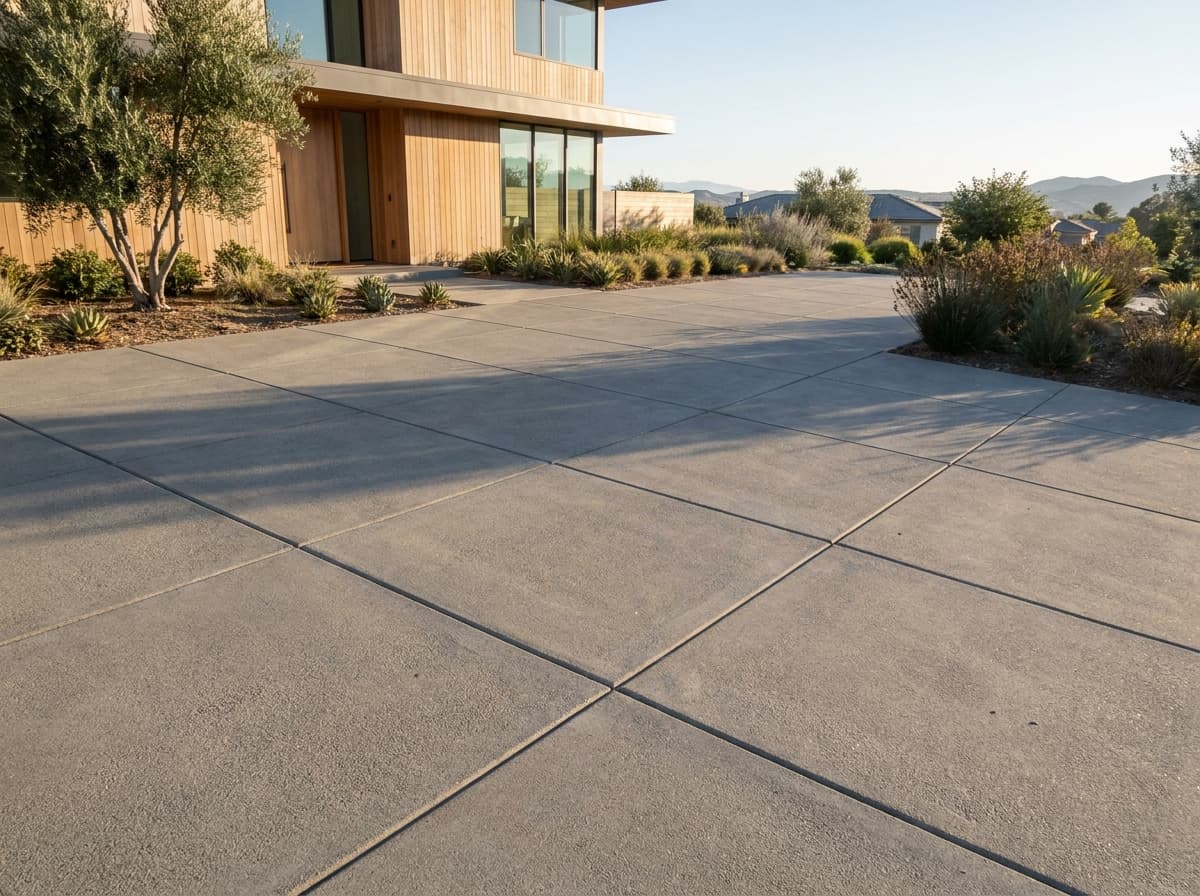
For a driveway, a walkway, a patio, or anything else outdoors that will get wet: broom finish. It is not the compromise answer, it is the correct one for most surfaces, and it is what we would put on our own houses.
Smooth, hard-troweled concrete belongs indoors or under a roof. Outside, it is slick when wet and it shows every flaw in the slab. Exposed aggregate is the durable, high-traction, high-character option that costs more, cleans harder, and is not comfortable on bare feet. All three are legitimate. They just belong in different places, and the reason people end up unhappy is almost always that a finish was chosen from a photo rather than from how the surface gets used.
The short version
| Finish | Grip when wet | Heat underfoot | Cleaning | Belongs on |
|---|---|---|---|---|
| Broom, medium | Good | Depends on color | Easy — hose and go | Driveways, walkways, most patios |
| Broom, fine or sand | Fair | Depends on color | Easy | Covered patios, low-traffic paths |
| Hard trowel (smooth) | Poor when wet | Hottest, holds heat | Easiest of all | Garages, shops, interiors, covered floors |
| Exposed aggregate | Excellent | Warm, but breaks contact | Hardest — texture holds debris | Driveways, slopes, high-traffic entries |
| Salt finish | Good | Moderate | Moderate — pits hold grit | Pool decks, patios |
| Knockdown texture | Good | Moderate | Moderate | Pool decks |
Broom finish
A broom finish is made after the slab has been floated flat and the bleed water has gone: the crew drags a broom across the surface, which lifts a shallow, consistent corduroy of ridges into the top layer.
That is the entire technique, and it is very good at its job. The ridges give you traction with water on the surface, they break up glare, they hide minor variations in flatness, they wear evenly, and they are easy to clean because there is nowhere for dirt to hide. It is also the least expensive finish available, which is unusual for a thing that is genuinely the right answer.
Two details separate a good broom finish from an indifferent one.
Direction. Broom lines should run across the direction of travel and across the direction of fall, not with it. Lines running downhill channel water; lines running across the slope break sheet flow and give a tire or a shoe something to bite into. On a sloped driveway, this matters more than the coarseness of the broom.
Consistency. Brooming is done in continuous passes with an even lift. Overlapping passes at different pressures leave the surface reading as a series of patches under low sun, which is when every flatwork flaw becomes visible. A finish that looks uniform at noon and blotchy at six in the evening was broomed unevenly.
Coarseness is a real choice. A coarse broom on a steep driveway or a boat ramp gives maximum grip and looks rugged. A fine or "sand" broom on a covered patio is gentler underfoot and quieter to look at, with less traction to spare. For a normal driveway, medium is the default and there is no cleverness to be had.
The honest downside: a broom finish is plain. It looks like concrete. If you want the front of the house to read as stone, brooming is not going to get you there, and a decorative border or a stamped band around a broom field is usually a better answer than stamping the whole thing.
Hard-troweled smooth concrete
A steel trowel, run repeatedly as the slab tightens, compacts and closes the surface until it is dense, flat, and slightly reflective. It produces the hardest, least absorbent, easiest-to-mop concrete surface there is.
Outdoors, it is a mistake in most locations, and we will say so before pouring one.
It is slippery when wet. Not "less grippy" — genuinely slick. A hard-troweled patio with a hose running across it, a smooth pool surround, a troweled entry that catches sprinkler overspray: these are the surfaces people fall on. Adding a film-forming sealer makes it worse.
It shows everything. A dense, flat, reflective surface is a mirror for every defect. Trowel burns show. Crazing — that fine web of surface lines that is cosmetically harmless on a broom finish — is plainly visible on a troweled slab, especially when it is wet. Any variation in color from an inconsistent pour shows. Hairline cracks that would disappear into a broom texture read as lines across a smooth floor.
It gets hot and stays hot. A dense surface with full contact against a bare foot transfers heat efficiently. Texture is what keeps a hot surface tolerable, and smooth concrete has none.
Where it does belong: garage floors, workshops, interior slabs, covered patios that never get wet, and anywhere you plan to polish or coat later. If you are drawn to the look of smooth concrete outdoors, the honest alternatives are a very fine broom, a light sand finish, or a knockdown texture — all of which read as smooth from a few feet away and are not dangerous.
Exposed aggregate
Exposed aggregate is the top layer of cement paste removed to reveal the stone in the mix. Two ways to get there:
Surface retarder and wash. A chemical sprayed on the fresh slab slows the set of the very top layer only. The next day, the crew washes and brushes that layer off, uncovering the aggregate underneath. What you see is whatever rock is in the concrete you ordered, so the appearance depends on the local aggregate supply — this is worth seeing a sample of, because it varies.
Seeded aggregate. Selected stone is broadcast onto the surface of the fresh slab and worked in, then exposed the same way. This is how you get river rock, specific colors, or a uniform pebble look that ordinary structural aggregate will not give you. It costs more and it is more labor.
What you get for the extra cost:
- The best traction of any concrete finish, wet or dry. This is why it shows up on steep driveways and ramps.
- Extraordinary durability. The wear surface is rock, not cement paste. Traffic lines that would eventually polish a broom finish flat do very little to exposed aggregate.
- It hides dirt and staining better than anything else, because the surface is already visually busy.
What you give up:
- Comfort. It is not pleasant barefoot for long, and it is unforgiving on knees. Around a pool where people walk barefoot constantly, this is a real objection.
- Cleaning. Leaves, needles, and grit sit down in the texture. A blower handles most of it; a broom does not. Anything sticky is a chore.
- Timing risk. The exposure window is short. Washed too early and stones come loose; washed too late and the paste will not release evenly, leaving a patchy surface. This is a finish where the crew's judgment on day two determines how it looks for thirty years.
- Sealing. Exposed aggregate looks dramatically better sealed — the stone color deepens the way a wet rock is prettier than a dry one — and a sealer also locks marginal stones in place. That means it joins the reseal cycle rather than being maintenance-free.
The other finishes worth knowing
Salt finish. Coarse rock salt is pressed into the fresh surface and washed out later, leaving shallow pits. It is a classic pool-deck finish: good grip, gentler on feet than exposed aggregate, and easy to color. The pits collect a little grit, and they are permanent, so it is a look you should like rather than tolerate.
Knockdown texture. A texture coat sprayed or troweled on and then flattened lightly, giving a soft, mottled, low-profile grip. Common on pool decks because it stays cool relative to smooth concrete and stays comfortable barefoot. It is a surface coating, so it lives or dies on the bond to the slab underneath and it eventually needs recoating.
Swirl or fan finish. Made with a float in overlapping arcs. Moderate traction, more decorative than broom, and it hides trowel marks well. Somewhat out of fashion, still a reasonable answer for a covered patio.
Stamped. A different conversation entirely — it is a decorative system with its own maintenance cycle rather than a finishing technique.
Slip resistance: the part sealer changes
Texture gives you grip. Sealer can take it away.
A film-forming sealer — the glossy kind that makes color look wet and rich — bridges shallow texture and puts a slick plastic layer on top. On a coarse broom finish it makes a modest difference. On a fine broom, a smooth trowel, or a lightly stamped surface, a glossy sealer is the difference between adequate and hazardous underfoot when wet.
Two ways to keep both:
- A grit additive mixed into the sealer. Fine polymer or silica grit suspended in the coat, restoring bite. We use it at steps, at pool edges, and on any sloped run, and it is essentially invisible.
- A penetrating sealer instead of a film. It soaks in and works from inside the concrete rather than sitting on top. It does not produce the wet-look sheen, and it does not reduce traction.
If a contractor is going to seal a walking surface, ask which of those is happening. "We seal everything" without a follow-up sentence is not an answer.
Heat: color first, texture second
People assume finish drives temperature. Mostly it is color. A dark charcoal slab is hot in any finish, and a light warm tone is meaningfully more comfortable in any finish.
Texture matters second, and it matters in a specific way: a textured surface reduces the contact area against a bare foot, so it transfers heat more slowly even at the same temperature. That is why a salt finish or a knockdown reads as cooler than a hard-troweled slab of identical color.
If barefoot comfort is a priority — pool deck, a patio where kids come out of the water — choose a light, warm color first, a textured finish second, and a non-glossy sealer third. In that order.
Where we would put each one
| Surface | What we would specify | Why |
|---|---|---|
| Driveway | Medium broom, run across the slope | Grip, easy cleaning, wears evenly, best value |
| Steep driveway or ramp | Coarse broom or exposed aggregate | Traction under a wet tire matters more than looks |
| Approach apron | Same as the driveway | Continuity, and it takes the most traffic of anything |
| Front walkway | Broom, or exposed aggregate with a broom field | Entry is where a decorative band earns its cost |
| Pool deck | Salt, knockdown, or light broom in a light color | Wet feet, bare feet, all afternoon |
| Covered patio | Fine broom or swirl | Never wet, so texture can be gentler |
| Garage or shop | Hard trowel | Dry, indoor, and you want to sweep it |
| RV pad | Medium broom | Grip, and it hides the marks a working surface collects |
| Steps | Broom across the tread, always | This is where falls happen |
Mixing finishes is usually the right call
The most common good-looking driveway we build is not one finish. It is a broom field with something else at the edges: an exposed-aggregate border, a stamped band in a contrasting color, a saw-cut pattern that breaks the surface into panels, or a soldier course of pavers along the edge.
You get the durability and low cost of broom across the large area that nobody looks at closely, and the decorative interest where the eye actually goes — the entry, the border, the transition to the walkway. It costs a fraction of stamping the whole surface and it usually looks better, because a large field of stamped pattern can read as busy in a way a border never does.
The one rule: control joints and finish transitions should be planned together. A decorative band that ignores the joint layout will get a crack across it.
How each one ages
Worth knowing what you are signing up for over a couple of decades, because none of these finishes stays exactly as poured.
Broom wears flat in the traffic lines first — the tire tracks and the path from the gate to the door. The ridges round off and the texture there gets shallower than the rest of the slab. It takes a long time, it is gradual, and it never reaches a point where you have to do anything about it. That is the whole appeal.
Hard trowel develops surface crazing that becomes more visible with age, and outdoors it can dust or spall if the slab was never properly cured. A troweled exterior surface that was rushed on a hot day will tell you about it for the rest of its life.
Exposed aggregate barely wears at all — the surface is rock — but the sealer on it does, and once the sealer is gone the stone looks dry and chalky compared to how it looked when it was new. It also loses the occasional stone at the edges over the years, which is normal and not a defect.
Salt and knockdown finishes hold their texture well. Knockdown is a coating, so it eventually needs recoating, and how long that takes depends mostly on sun exposure and traffic.
The pattern: uncoated finishes fade quietly and coated finishes reach a point where somebody has to do something. Neither is wrong. Pick the one that matches how much attention this surface is actually going to get.
What to ask
- Which direction do the broom lines run? Across the slope and across traffic. If the answer is a shrug, notice that.
- Is this getting sealed, and with what? Film or penetrating. If film, on a walking surface, ask about grit.
- Can I see this finish in this color, dry and wet, before you pour? A sample board costs nothing and settles arguments. Concrete color always looks different in the yard than on a chart.
- For exposed aggregate: what aggregate, and can I see it? The rock available locally is what you are getting unless you are paying to seed something specific.
- How does the finish relate to the joint layout? Decorative bands, borders, and pattern lines should be planned with the joints, not around them afterwards.
- What is the maintenance on this finish? Broom: essentially none. Exposed aggregate and anything sealed: a recurring cycle. Both answers are fine. Not being told is not.
Broom-finish and decorative driveways, approach aprons, and reinforced RV pads that carry the load and drain right.
Read next
- How Thick Should a Concrete Driveway Be?Four inches, six, or more — what actually decides driveway thickness, why the base matters more than the number, and where RV pads differ.10 min read
- Why Concrete Cracks, and Which Cracks MatterAll concrete cracks. How to tell a harmless shrinkage hairline from a crack that means the base under your slab has failed, and what to do about each.12 min read
- How Long Before You Can Drive on New Concrete?Foot traffic in about a day, vehicles in about a week. Why the 28-day figure is misunderstood, what damages young concrete, and how heat changes a cure.11 min read