
Does Artificial Turf Smell With Dogs?
Yes if it is never rinsed, no if the base drains and somebody hoses it down. Base permeability, infill choice, and what the maintenance honestly involves.
· 10 min read
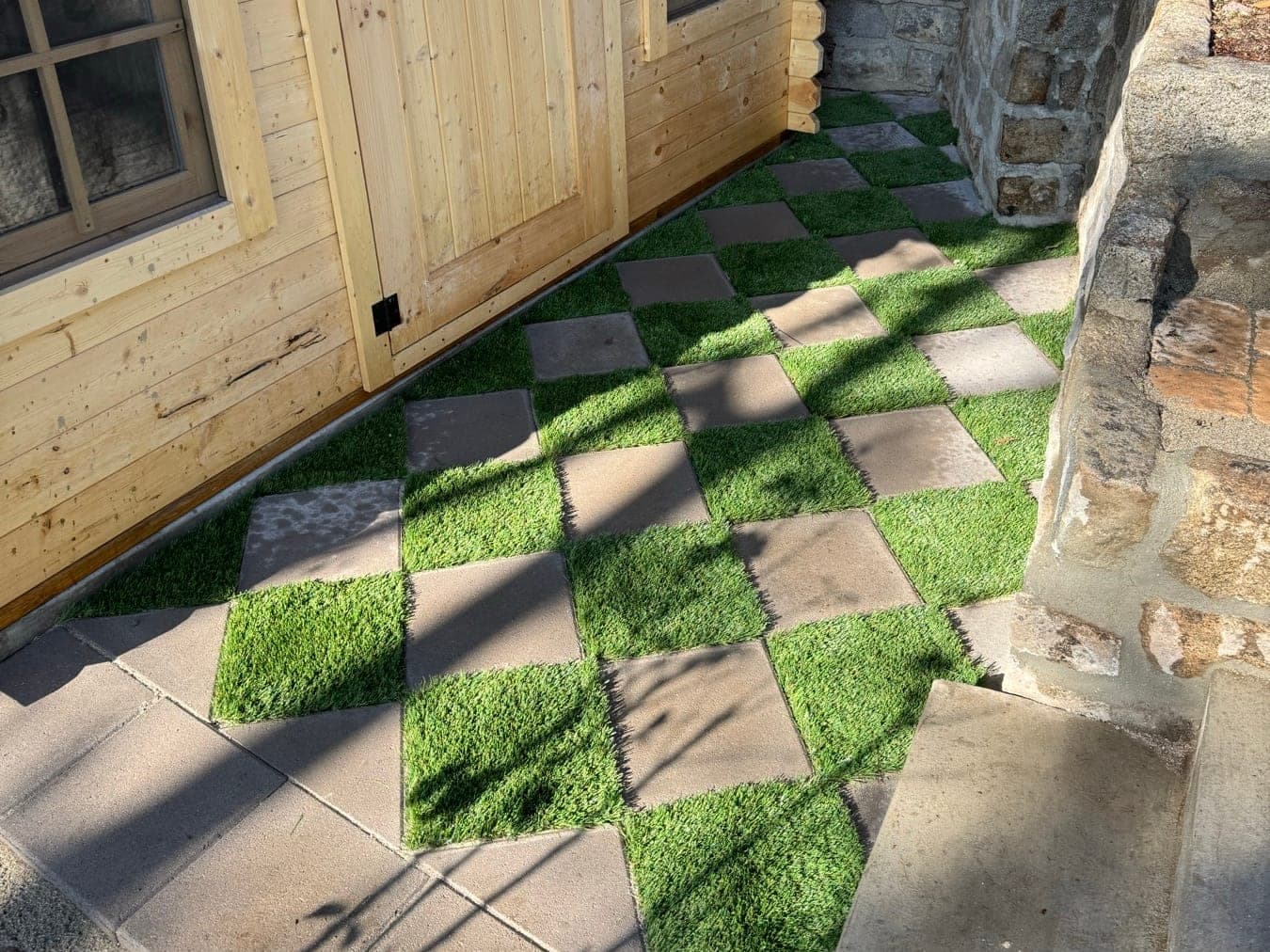
Yes, if it does not get rinsed. No, if the base drains and somebody hoses it down on a schedule. That is the honest version, and no product claim changes it.
Turf does not absorb anything — the blades and backing are plastic. But the surface it makes, the infill sitting between the blades, and the base underneath it are all places residue can stay, and residue plus warmth plus time is what you are actually smelling. Build it to drain, rinse it, and it is a genuinely good surface for dogs. Build it like an ordinary lawn panel, ignore it, and it will announce itself by the second summer.
Where the smell comes from
Dog urine is mostly water. The water leaves — that part takes care of itself. What stays behind is urea and salts, and bacteria break those down into ammonia. That ammonia smell is the sign that residue never got flushed out and something is living on it.
Two things make it worse, and both are predictable:
- Heat. Everything volatilizes faster on a hot surface. A turf panel in full afternoon sun runs meaningfully hotter than living grass, so a yard that smells like nothing in February can be obvious at four in the afternoon in August.
- Rewetting. The first rain after a dry stretch, or the first rinse after a month of not rinsing, lifts old residue and you smell all of it at once. People often conclude the rinse caused the problem. The rinse revealed it.
Solid waste is a separate issue with the same cause. It does not decompose into the base the way it would on soil — it sits on top, and whatever is left behind after pickup stays in the blades until water moves it.
The base decides almost everything
This is where a pet turf installation is genuinely different from a standard one, and it is the part that cannot be added later.
A normal turf base is compacted aggregate with fines in it — decomposed granite or class II — and it is compacted hard, in lifts, because that is what keeps a turf panel flat for ten years. It is a good base. It is also, by design, fairly dense, and liquid does not go through it quickly. Rain sheds off the shaped surface and finds a drain, which is exactly what you want under a lawn panel and exactly wrong under a dog.
For a dog area we build an open-graded base instead: clean, angular crushed rock with the fines screened out, compacted, so urine goes straight down through the void space instead of pooling in the infill and sitting there.
The honest trades that come with it:
- It needs a separation fabric underneath. Clean rock sitting directly on soil works its way down into the soil over time, and the base thins and settles. Geotextile between the two stops that.
- It is harder to finish dead flat. Rock without fines does not screed to a fine tolerance the way a base with fines does. Getting a pet base genuinely level takes more time, and a crew that is rushing will leave you a surface that reads slightly loose underfoot.
- It does nothing on its own if the subgrade is a bathtub. This is the failure we see most in pet installations: a perfectly built open base sitting in a clay bowl with no outlet. Water and everything in it goes down four inches, hits clay, and stops. Now the residue is being held right under the turf rather than in it, which is worse, because you cannot rinse what you cannot reach.
On clay, an open base needs somewhere to send what it collects — a perforated line running through the base to a discharge point, or a sump, or a shaped subgrade falling to a drain at the low edge. That is a real line item and it belongs in the quote.
Backing and infill
Backing. Turf backing is either hole-punched at intervals or fully permeable across its whole area. Hole-punched backing has a stated flow rate that is more than adequate for rain and less obviously adequate for a dog that uses the same square yard every day. Flow-through backings exist specifically for pet applications and are worth asking about by name.
Either way, the backing is only as good as what is under it. Laying turf over an impermeable pad, or over a sound concrete slab with nowhere for water to go, puts a lid on the problem.
Infill. This is the choice people are most often not told about, and it matters:
| Infill | How it behaves with dogs |
|---|---|
| Plain silica sand | Cheapest, holds blades up well, and angular grains hold a film of residue. The usual culprit in a turf that smells. |
| Coated or acrylic-sealed sand | Smoother, sealed surface with less for bacteria to cling to, and it drains and rinses more cleanly. |
| Zeolite | A natural mineral that adsorbs ammonium ions. Genuinely reduces ammonia odor. Rechargeable with a rinse. |
| Crumb rubber | Holds heat, holds odor. Not what we use in a dog area. |
| Organic infills (cork, coconut, walnut) | Cooler underfoot, but organic material plus urine plus heat is its own smell problem over time. |
Zeolite is the one worth understanding properly, because it gets sold as if it were permanent. It works by capturing ammonium ions in its structure, which is real chemistry and does real work. But its capacity is finite. It needs recharging — a thorough rinse, or a dilute neutralizing rinse, releases what it has captured and puts it back to work. Over years it also breaks down and gets dusty, and it needs topping up. And it does nothing at all about solids left on the surface.
So zeolite reduces the maintenance requirement. It does not remove it. Anyone who tells you an infill means you never have to rinse is selling you the future version of this problem.
What maintenance actually looks like
Specifically, so you can decide honestly whether it will happen:
- Solids picked up daily. Same as a lawn. Whatever is left behind after pickup is what water has to move.
- A rinse of the dog area weekly in mild weather, and more like twice a week through the hot months. A hose on a normal nozzle for a couple of minutes over the area that gets used — not a full yard wash.
- An enzymatic cleaner monthly if there is a dog with a favorite corner, or seasonally otherwise. Enzymatic products digest the residue rather than covering it, which is the difference between a fix and a fragrance.
- Brushing against the blade lean a few times a year in traffic areas, which keeps the blades standing up, lifts debris out of the pile, and redistributes infill.
- Topping up infill every few years, and sooner in the concentrated spot.
The single biggest predictor of whether that happens is whether there is a hose bib near the dog area. If rinsing means dragging fifty feet of hose around the side of the house, it will happen for two months and then stop. Put the bib where the dog goes and the whole thing becomes a ninety-second job.
What not to do
- Bleach. It does not remove the source, it can damage backing and fibers, and it is unpleasant for the dog that lives on the surface.
- A pressure washer on full. It strips infill out, frays the fiber tips, and lifts seams. A pressure washer at low pressure with a wide fan is fine; the same tool at full trigger is a way to age turf several years in an afternoon.
- Heavy vinegar routines. Vinegar masks ammonia temporarily and it is acidic on fibers over the long run. It is a stopgap, not a maintenance plan.
- Letting one corner become the only spot. A dog that uses a single square yard concentrates everything, and that corner will need its infill replaced long before the rest of the panel. Spreading the use out, or accepting that one small area is a wear item, both beat pretending it is not happening.
If the turf you already have smells
Most of the pet turf we get called about is somebody else's install, two or three summers old, and the diagnosis usually comes down to one of four things. It is worth working through them in order, because the fixes get progressively more expensive.
Start with a deep clean. A thorough rinse, then an enzymatic treatment applied heavily enough to actually reach the base of the pile rather than misting the tips, then another rinse. If the smell drops sharply and comes back in a few weeks, the build is fine and the maintenance schedule is the problem.
Then check whether water is leaving. Run a hose in one spot for a minute and watch. Water should disappear as fast as you can put it down. If it pools, sits, or spreads sideways across the surface, the base has clogged with fines, the backing perforations are blinded, or there is nothing underneath that drains. Pooling is the tell that the problem is structural rather than a cleaning gap.
Then look at the infill. Pull the blades apart in a used area and look at what is between them. Infill that is discolored, crusted, or has visibly migrated away leaving bare backing is infill that has stopped working. Replacing infill in a concentrated area is disruptive but it does not require lifting the panel.
Then consider the base. If water does not go anywhere and the infill is fine, the base has fines in it, it has silted up, or it is sitting on clay with no outlet. That one is a rebuild of that area, and it is the reason the base question is worth asking hard before the turf goes down rather than after.
The pattern that tells you it is the base: the smell is worst after rain, it is concentrated in the low part of the yard, and no amount of cleaning holds for more than a week.
The comparison that actually matters
The fair question is not whether turf smells. It is which failure mode you would rather own.
Real grass never smells. It also gets urine burn spots, wears paths where the dog runs, and needs patching. Grasses that spread by runners grow back through damage on their own; clumping grasses do not, and a fescue lawn with an enthusiastic dog develops permanent bald lines.
Turf never burns and never wears a path. It also needs a person with a hose, forever, and it gets hot in full sun in a way that matters for paws on an August afternoon.
One of those failures fixes itself if you leave it alone. The other one fixes itself only if you show up. That is the actual choice, and it comes down to who is in the house rather than to which product is better.
Shade is worth mentioning in the same breath, because it changes both problems at once. A dog run on the north side of the house or under a tree is cooler, smells less, and is a fundamentally different experience from the same build in an open south-facing lot.
What to ask before it goes in
- What base material, and does it have fines in it? For a dog area you want to hear clean, open-graded rock.
- Is there a separation fabric under the base? There should be, or the rock migrates into the soil.
- What is under the base, and where does liquid go once it is through? On clay this is the question that decides everything.
- Which infill, and why? Zeolite or a coated sand, with a reason attached to your dog, not to the price list.
- What is the backing — hole-punched or flow-through? And what is its flow rate.
- Where is the nearest hose bib to the dog area? If the answer is "the other side of the house," fix that while the yard is open.
- How do the seams and edges get secured? A dog digging at a loose edge finds it faster than you will.
- What does the maintenance schedule look like, in plain terms? If the answer is "none," ask a different question and see whether the story stays consistent.
Turf over a compacted, draining base, with seams you cannot pick out and edges that stay where we put them.
Read next
- Artificial Turf vs Sod in Southern CaliforniaWater, heat, upkeep, pets, and what each actually costs to own over ten years — an honest comparison from a crew that installs both.11 min read
- How to Water New SodThe six-week taper from short and frequent to deep and infrequent, the tug test, and the common mistake that kills more new lawns than anything else does.11 min read
- Which Grass Survives a Southern California Summer?Warm season versus cool season, what each one costs you in water and winter color, and how many hours of sun your yard actually gets before you choose.10 min read