
Artificial Turf vs Sod in Southern California
Water, heat, upkeep, pets, and what each actually costs to own over ten years — an honest comparison from a crew that installs both.
· 11 min read
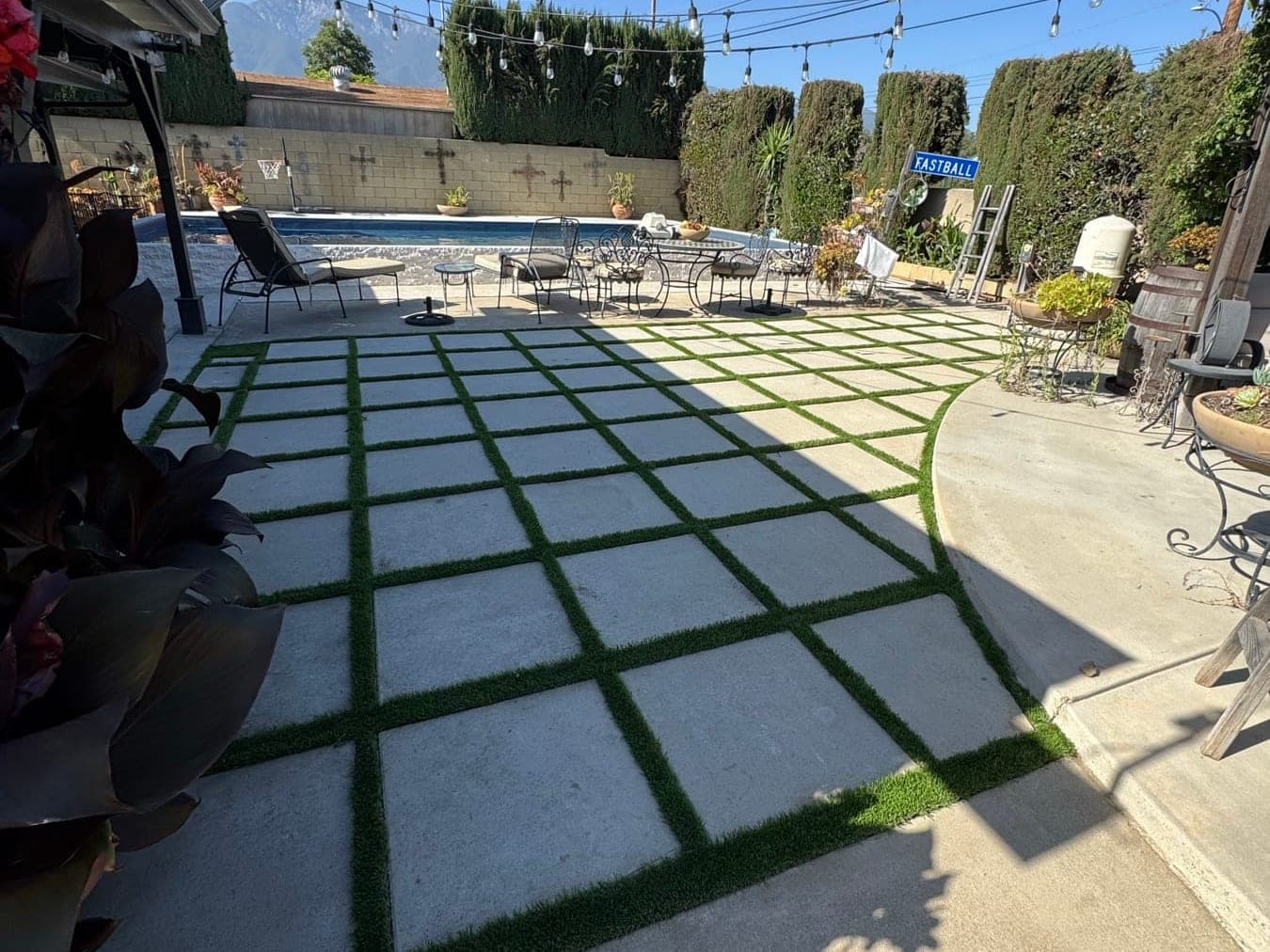
We install both, which means we have no particular stake in talking you into either one. What we do have is a lot of experience with which yards end up happy and which end up calling us back — and the pattern is clearer than the marketing on either side suggests.
Here is the honest version.
The decision is not really "turf or grass"
It is a trade between money now and work later, and between water and heat.
Turf costs considerably more to install and almost nothing to run. Sod costs less to install and then bills you every month, in water and in time, forever. Turf never browns and never needs mowing; it also gets hot, has a finite lifespan, and cannot be repaired invisibly. Sod is cool underfoot, self-repairing, and genuinely alive; it also dies if the irrigation fails for a week in August.
Neither of those is a flaw. They are just different deals.
Water
This is the honest headline for turf and there is no arguing with it: a real lawn in Southern California drinks a lot of water, most of the year, every year. Turf drinks essentially none.
But two things get overstated:
- Sod's water use is not fixed. A properly zoned system watering deeply and infrequently, with the right grass for the exposure, uses dramatically less than a badly zoned one running short daily cycles. A lot of "lawns use too much water" is really "that lawn was watered wrong."
- Turf is not zero-maintenance water. It gets rinsed — more often if you have dogs, and on hot days people hose it down to bring the surface temperature back to something walkable.
If reducing water is the main goal and you are choosing between them on that basis alone, turf wins clearly. Just know that a third option exists: a smaller real lawn, with the rest of the yard in planting and hardscape, often gets most of the water saving while keeping the part of the lawn you actually use.
Heat
This is turf's real downside and the one most likely to surprise you.
Any synthetic surface in full Southern California sun runs meaningfully hotter than living grass. Grass cools itself by transpiring; turf cannot. On a hot afternoon in full sun, turf can be uncomfortable to stand on barefoot and hot enough to matter for a dog's paws.
What helps:
- Shade, more than anything else. Turf under a tree or on a north-facing yard is a completely different experience from turf in an open south-facing lot.
- Infill choice. Some infills hold less heat than plain silica sand.
- A rinse, which drops the surface temperature quickly and briefly.
What does not help is any product claim to the contrary. If a barefoot play area in full afternoon sun is the main use of the space, we will say so during the walk rather than after it is installed.
Upkeep, side by side
| Sod | Artificial turf | |
|---|---|---|
| Weekly | Mowing in season | Nothing |
| Monthly | Edging, watering checks | Rinse, more with pets |
| Seasonally | Fertilizer, aeration, overseeding some varieties | Brush the high-traffic lines |
| Occasional | Patching worn spots, adjusting irrigation | Topping up infill |
| Lifespan | Indefinite with care | Finite — eventually replaced |
| Fails by | Drying out, compaction, drainage | Base settling, matting, seam lift |
The row that matters most is the last one. Sod fails in ways you can fix. Turf fails in ways you cannot. A worn patch of lawn gets patched and disappears in a month. A rippled turf panel is rippled until someone pulls it up and redoes the base.
The ten-year view
Turf's whole argument is ownership cost. Roughly, the shape of it:
- Turf is a large payment once, near-zero running cost, and then a replacement at the end of its life. Most of the total is spent on day one.
- Sod is a much smaller payment once, then a steady monthly cost in water plus either your Saturday mornings or a gardener, indefinitely.
Where the crossover lands depends on your water rate, the size of the lawn, whether you mow it yourself, and how long you stay in the house. For a small lawn on a property you might sell in five years, sod is usually the better financial call. For a large panel in a house you intend to keep, turf's arithmetic tends to win.
We give you real numbers for your actual yard at the estimate. Anyone quoting a per-square-foot figure over the phone has not seen your base, your drainage, or your access.
Dogs
Turf works well for dogs, with the build changed for it: a more open base so urine drains straight through instead of sitting in the infill, and an infill that does not hold odor.
The caveat is unavoidable — it still needs rinsing. Turf that never gets hosed will eventually smell, regardless of what it is made of or what the brochure says. If nobody in the house is going to rinse it, that is worth knowing before rather than after.
Sod with dogs is the opposite problem: dogs wear paths and burn spots, and a lawn with an enthusiastic dog on it needs patching. It just never smells.
The part that matters more than the choice
Whichever you pick, the failure mode is the same, and it is underneath.
Turf lives or dies on its base. Excavate, compact in lifts, shape to drain. A base that settles gives you dips and wrinkles that no amount of brushing will pull out, and the turf itself almost always outlasts the base beneath it.
Sod lives or dies on what is under it too — most of the lawns we replace were laid straight onto compacted builder's fill or clay that sheds water instead of taking it. Rip it, amend it, grade it away from the house, get the irrigation in and tested before the sod is delivered.
The uncomfortable version of this: a cheap turf job on a bad base is a worse outcome than a good sod job, and a cheap sod job on a bad grade is a worse outcome than good turf. The quality of the prep matters more than which surface you chose.
Where each one clearly wins
Choose turf if: the lawn is mostly ornamental, the yard is shaded or small, water is the deciding factor, you have dogs and will rinse, or nobody in the house wants to own a mower.
Choose sod if: kids play on it barefoot in summer, the yard gets brutal afternoon sun, you want it cool underfoot, you like the yard being alive, or you may sell before turf's cost has amortized.
Choose both more often than people expect. A real lawn panel where people actually sit and play, turf in the side yard and the dog run, planting and hardscape everywhere else. That is the layout that makes most Southern California yards work, and it is what we end up recommending more than either extreme.
What to ask, either way
- What is the base build, and is it compacted in lifts? For turf especially, this is the whole job.
- Where does water go? Both surfaces need somewhere for it to leave.
- For turf: which infill, and why? There should be a reason, and it should relate to your use.
- For sod: which variety, and why that one? Sun, traffic, and water tolerance should be in the answer.
- For sod: is irrigation in and tested before delivery? Sod on a pallet in the sun is losing every hour it waits.
Turf over a compacted, draining base, with seams you cannot pick out and edges that stay where we put them.
Read next
- How to Water New SodThe six-week taper from short and frequent to deep and infrequent, the tug test, and the common mistake that kills more new lawns than anything else does.11 min read
- Which Grass Survives a Southern California Summer?Warm season versus cool season, what each one costs you in water and winter color, and how many hours of sun your yard actually gets before you choose.10 min read
- Does Artificial Turf Smell With Dogs?Yes if it is never rinsed, no if the base drains and somebody hoses it down. Base permeability, infill choice, and what the maintenance honestly involves.10 min read